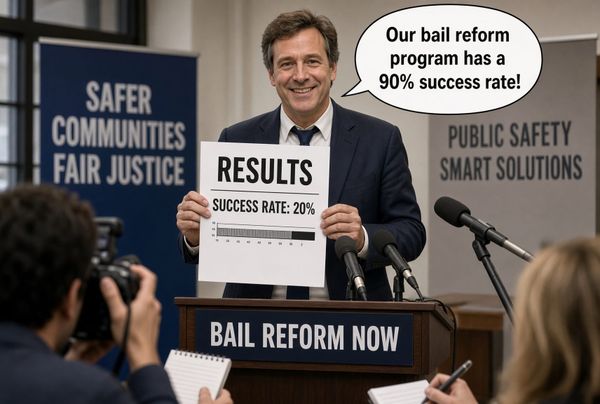
Washington’s Proposed Bail “Reforms” Would Sacrifice Public Safety for Ideology
In a recent opinion piece in the Seattle Times, David Montes of the ACLU of Washington and Maddisson Alexander of Civil Standard, argue that cash bail is a discriminatory tool that punishes poverty and violates the presumption of innocence.
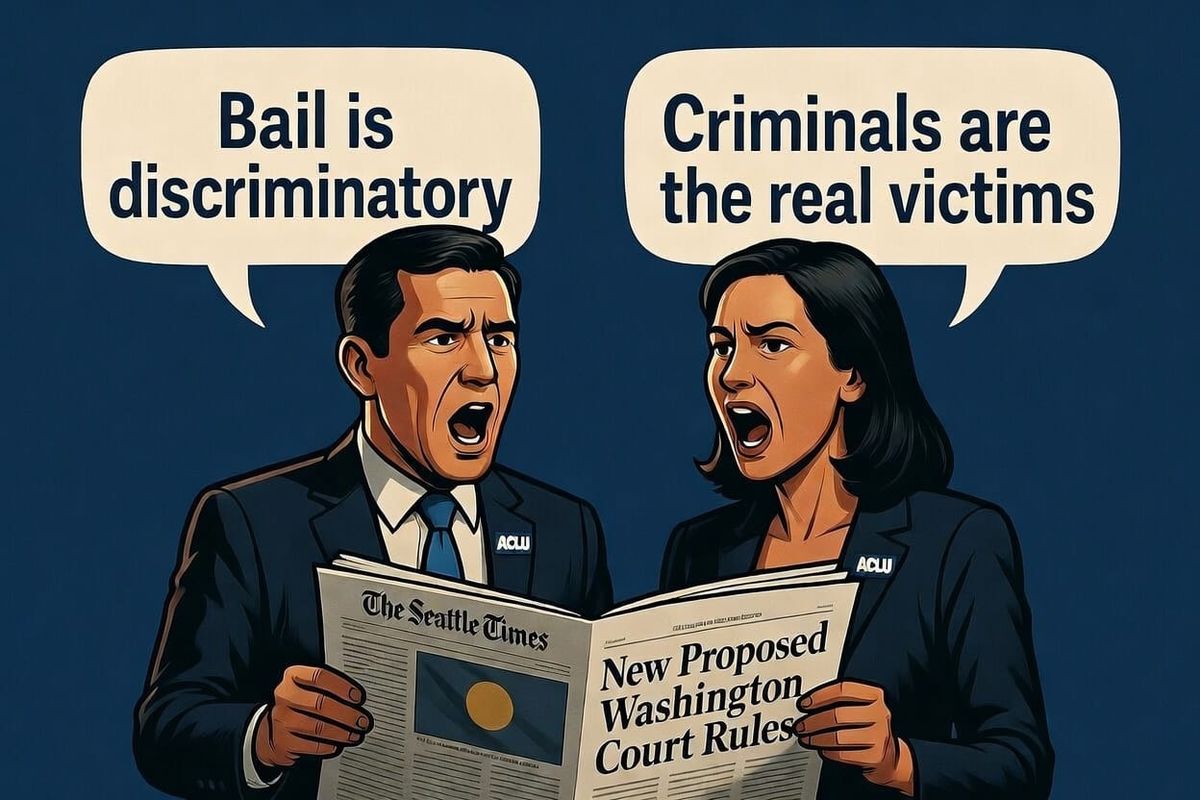
In a recent opinion piece in the Seattle Times, David Montes of the ACLU of Washington and Maddisson Alexander of Civil Standard, argue that cash bail is a discriminatory tool that punishes poverty and violates the presumption of innocence. Their op-ed urges the Washington State Supreme Court to adopt sweeping rule changes to CrR/CrRLJ 3.2 and related rules—changes that would require intentional failure to appear before bail can be imposed, cap bail at $200 for most misdemeanors (with narrow exceptions), and let defendants post just 10% of the bond amount directly with the court instead of through licensed and regulated bail bondsmen. These sound compassionate on paper. In practice, they would erode accountability, weaken enforcement, and put communities at greater risk—all while pretending that financial incentives and judicial discretion have no role in ensuring people show up for court or refrain from new crimes.
Let’s start with the basics the ACLU glosses over. The presumption of innocence does not mean “no conditions pretrial.” Every legal system balances the rights of the accused with the public’s right to safety and the integrity of the courts. Bail exists to give defendants skin in the game, so they appear and to protect victims and neighborhoods from repeat offending while cases wind through the system. Montes and Alexander dismiss concerns about crime and failure-to-appear (FTA) as “fearmongering” from the bail industry. But local prosecutors—who actually handle these cases day in and day out—are sounding alarms. Pierce County Prosecuting Attorney Mary Robnett has called the proposal “ludicrous” and “contrary to public safety.” King County prosecutors have raised similar objections. They know that low-level misdemeanors often involve repeat players whose cumulative impact on neighborhoods is real.
The “intentional” failure-to-appear requirement is particularly unworkable. How exactly does a judge determine intent when someone misses court because of a claimed “car trouble” or “medical emergency”? This creates a new layer of litigation and a presumption against accountability. Judges already have discretion to consider circumstances; the proposal handcuffs them and defaults to release. Courts are not social service agencies equipped to chase every excuse. The result will be more no-shows, more bench warrants that go unserved, and more cases dismissed because defendants simply disappear.
The $200 misdemeanor cap is equally detached from reality. Montes and Alexander cite the horror of $5,000 bail for stealing $20 worth of food. Fair enough—excessive bail for minor first offenses is poor policy. But the blanket cap ignores defendants with lengthy records, domestic violence histories (even if excluded in name), or patterns of theft, assault, or DUI who cycle through the system. For many, $200 is pocket change or easily borrowed. It sends the message that low-level offending carries no real pretrial consequence. Communities already strained by property crime, retail theft, and quality-of-life offenses will pay the price.
Then there is the 10% deposit paid directly to the court. This is the provision that most directly threatens the current system’s enforcement mechanism. Commercial bail bondsmen do not just take money and vanish; they have a powerful financial incentive to ensure defendants appear. If the defendant skips, the bondsman loses the full bond and often pursues the fugitive aggressively—something courts and sheriffs’ offices are not structured or funded to replicate at scale. Handing 10% to the court removes that private-sector accountability lever. The court gets a small deposit and has little skin in the game to chase absconders. Prosecutors rightly warn this is not a minor tweak; it is effectively a step toward eliminating meaningful oversight for pretrial releasees.
Montes and Alexander claim “robust empirical studies” and reforms in Kentucky and Vermont prove bail changes cause no crime spike. The evidence is far more mixed than he admits. The Brennan Center’s survey of 33 cities is frequently cited by reformers, but other rigorous analyses tell a different story. A detailed examination of Cook County, Illinois, bail reform found that expanded pretrial release correlated with a 45% increase in new crimes committed by releasees and a 33% rise in new violent crimes. New York’s bail reforms produced statistically significant increases in pretrial re-arrests—especially felony re-arrests—among higher-risk defendants in the immediate pretrial period. Studies comparing release types have sometimes shown commercial surety bonds producing modestly better appearance rates than unsecured or recognizance releases precisely because of the financial stake and monitoring. Pretrial detention and monetary conditions are not perfect, but the notion that they have zero deterrent effect on FTA or new criminal activity is not supported by the full body of research.
The ACLU frames opposition as self-interested bail industry lobbying. Yet public defenders have their own institutional incentives, and their proposals here prioritize defendant outcomes over victim safety and court efficiency. Washington does not need to choose between compassion and safety. Judges should retain discretion to set meaningful conditions based on offense, criminal history, and flight risk. Removing the tools that have worked—financial accountability and bondsman enforcement—risks repeating the mistakes seen in jurisdictions that later had to walk back overly aggressive reforms.
The Washington State Supreme Court has a chance to reject these changes before they take effect. Public comments are due by April 30. For the sake of victims, neighborhoods, and the rule of law itself, the court should preserve judicial discretion and the proven mechanisms that keep defendants accountable. Pretrial justice should not come at the expense of public safety.