Bail's Effectiveness Comes from the Powerful Incentives it Creates
The second study in AIA Surety's article series on the best bail studies ever conducted is the 2004 study by economists Eric Helland and Alexander Tabarrok, titled “The Fugitive: Evidence on Public Versus Private Law Enforcement from Bail Jumping.”
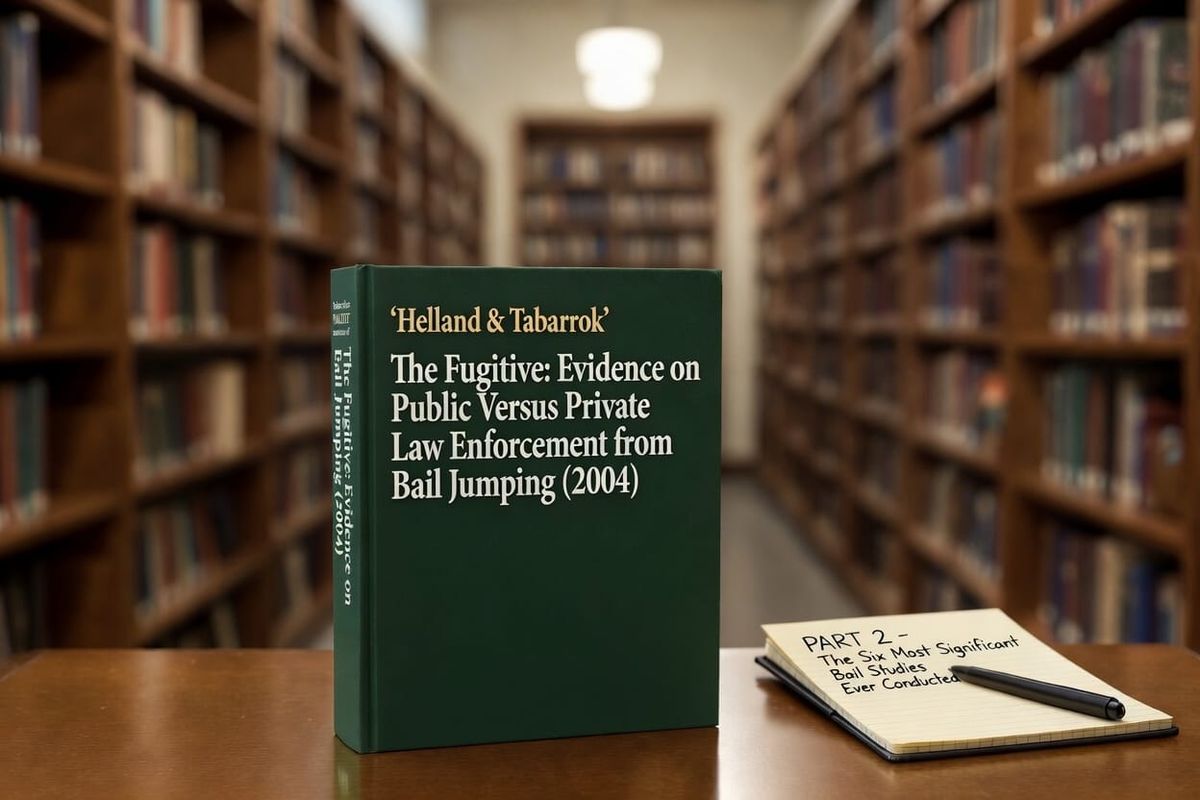
Helland & Tabarrok' The Fugitive: Evidence on Public Versus Private Law Enforcement from Bail Jumping (2004) - Article #2 in AIA Surety's Research Series, The Best Bail Bond Studies Ever Conducted
The second study in AIA Surety's article series on the best bail studies ever conducted is the 2004 study by economists Eric Helland and Alexander Tabarrok, titled “The Fugitive: Evidence on Public Versus Private Law Enforcement from Bail Jumping.” This groundbreaking study provides strong evidence that commercial surety bonds are significantly more effective than unsecured release at ensuring defendants return to court. Using nationally representative data from the Bureau of Justice Statistics on felony defendants and employing rigorous propensity score matching to control for factors like age, criminal history, and charge severity, the researchers found that defendants released on surety bonds had a failure-to-appear (FTA) rate of only 17%, compared to 26% for those released on their own recognizance. After statistical controls, surety-bond defendants were still 28% less likely to fail to appear. Even more notably, when defendants did jump bail, those on surety bonds were 53% less likely to remain at large for long periods, resulting in a 64% lower probability of becoming a long-term fugitive.
The study’s most important contribution lies in its explanation of these results: the powerful financial incentives created by the private surety system. Unlike public law enforcement, which bears the primary burden of pursuing defendants released on recognizance or unsecured bonds, commercial bail bondsmen are financially liable for the full bond amount if the defendant fails to appear. This “skin in the game” motivates bondsmen and bounty hunters to actively monitor, remind, and apprehend defendants. Helland and Tabarrok’s analysis demonstrates that this market-driven private enforcement mechanism substantially outperforms reliance on government resources alone, making secured surety bonds a proven and effective tool for improving court appearance rates and reducing fugitives in the ongoing bail reform debate. An excerpt from AIA Surety's article is below as well as a link to the full article.
Part 2: Helland & Tabarrok
The Fugitive: Evidence on Public Versus Private Law Enforcement from Bail Jumping (2004)
by Eric Granof
In the ongoing debate over bail reform and pretrial release, one question stands out: What actually works best at getting defendants back to court?
The second bail study in our six-part article series on the most significant bail studies ever conducted helps answer this question. A highly regarded peer-reviewed study published more than two decades ago provides some of the clearest economic evidence yet that financially secured release through a commercial surety bond outperforms unsecured options like release on recognizance (ROR). READ THE FULL ARTICLE HERE>>>