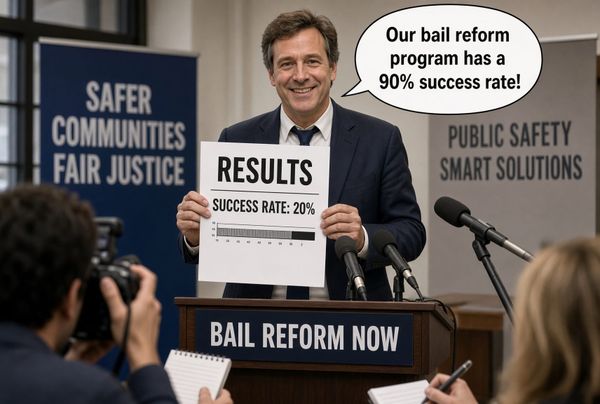
Beware of Sad Stories: How Bail Reform Proponents Try to Shape Policy with Empathy
In a recent post on Facebook, Mike Morrison, President of the Mississippi Bail Agents Association, criticizes a growing trend in the anti-surety bail movement that elevates personal storytelling over measurable data and outcomes.

In a recent post on Facebook, Mike Morrison, President of the Mississippi Bail Agents Association, criticizes a growing trend in the anti-surety bail movement that elevates personal storytelling over measurable data and outcomes. Morrison argues that recent pieces, such as one from the CEO of the Bail Project, use compelling narratives about lived experiences and empathy to shape public opinion on pretrial policy. While these stories may appear thoughtful and emotional, Morrison contends they function more as advocacy sales tools than as legitimate evidence, deliberately sidestepping the rigorous standards of proof that should guide public policy decisions.
Morrison challenges the central claim that stories should be treated as a valid form of data. He explains that true data must be structured, verifiable, consistent, and testable, whereas curated stories are inherently subjective and selective. He points to the Bail Project’s self-reported statistics—supporting over 40,000 people with a claimed 92 percent court appearance rate—as misleading because they come from a highly managed intervention program that includes reminders, transportation, and supervision, not from a neutral, real-world system without financial accountability. Morrison also questions the article’s reliance on a “2024 Georgetown survey,” noting it appears to recycle older research presented as new evidence, which undermines its credibility.
He warns that substituting narratives for hard metrics is especially dangerous in the criminal justice system, where decisions affect public safety, court efficiency, victim rights, and judicial integrity. Without clear methodology, verification processes, or bias controls, claims of a “comprehensive narrative dataset” on pretrial injustice remain rhetorical rather than analytical. Morrison emphasizes that storytelling can bypass scrutiny and sway public perception even when it does not reflect broader realities, such as failure-to-appear rates or warrant backlogs.
Ultimately, Morrison asserts that genuine pretrial reform must prioritize measurable outcomes—like court appearance rates, warrant clearance, and case completion—rather than emotional narratives. He concludes that the surety bail system provides enforceable accountability at no cost to taxpayers and that allowing storytelling to replace evidence risks making accountability optional, a standard the justice system cannot afford.
Morrison references the following article in his post.
 David Gaspar