Should More Detention Be the Solution to Failed Bail Reform?
In a recent editorial in thecity1, Whiteside County Sheriff John F. Booker talks about Illinois failed bail reform
Illinois' Elimination of Cash Bail Continues to Show Signs of Failure...and Still No One Sees the Obvious Solution
In a recent editorial in thecity1, Whiteside County Sheriff John F. Booker talks about Illinois failed bail reform. His comments are spot on, and he is not wrong about the problem. He is just wrong about the fix.
On September 9, thecity1 published his editorial asking Illinois to reopen the pretrial release laws that replaced cash bail. He describes a grimly ordinary week: four people booked on September 1 for failing to appear or violating release conditions; another arrest on September 2 of someone who had cut a GPS monitor in a different county and was then accused of attempted carjacking and trying to disarm an officer. Those are not abstract talking points. They are the daily residue of a system that opens the jail door and then hopes.
Booker wants stronger, faster consequences when someone willfully misses court, repeatedly breaks conditions, tampers with a monitor, or picks up a serious new charge. He wants judges to be able to treat that conduct as relevant to custody. He says this is not a call to jail every arrestee, and that the accused remain presumed innocent. Fair enough. Then he stops.
At no point does he even consider or mention bringing bail back to Illinois.
That omission matters. The failures he lists — failure to appear, condition-breaking, monitor-stripping, new alleged crimes, a thinning respect for court orders — are exactly the failures a third-party surety is built to absorb. Illinois did not merely change how much money a defendant needed. It moved responsibility off private shoulders and onto government forms, GPS vendors, and sheriff’s deputies who now chase people the old system used to have a reason to produce.
The accountability vacuum
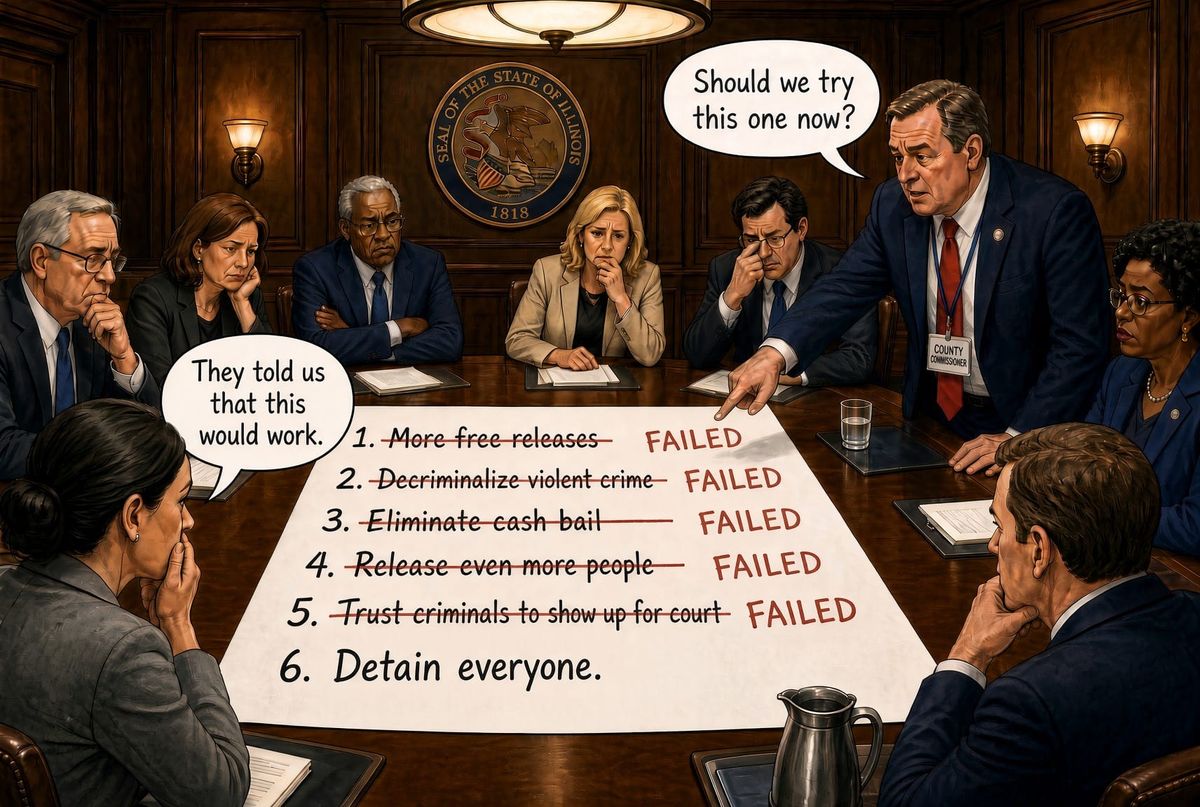
Pretrial reform in Illinois was sold as the end of wealth-based detention. When bail was eliminated, reformers treated “cash” as the whole institution of bail, and treated government supervision as the civilized substitute. What we are seeing now is the result of a misdiagnosed problem. Bail wasn't the problem in Illinois. The problem was unaccountable release. Eliminating the strongest component of accountability...bail... and prescribing more of the things that don't work, like government oversight with no accountability, only leads to one result...more problems, more crime and less accountability. A perfect snapshot of today's Illinois.
A surety is not a pile of cash in a clerk’s drawer. Historically it is a person — family, employer, neighbor, or a commercial surety backed by indemnitors — who stands behind appearance. Someone outside the state has accepted a risk if the defendant disappears. That is different from an unsecured promise, different from a text-message reminder, and different from an ankle bracelet that the defendant can cut.
When that third party disappears from the design, three things follow, and Booker’s blotter is all three.
Failures to appear become a police problem. If no one loses money, reputation, or a co-signed obligation when the defendant skips, the only locator left is a deputy. Four bookings in one day for FTA or condition violations is what “the system” looks like when the system is the sheriff.
Recidivism while the case is pending becomes a supervision problem. GPS is not accountability. It is a signal. Booker’s second example is the tell: the monitor came off, new alleged violence followed, and the next county’s deputies inherited the mess. Electronic monitoring without a human being who will look for the wearer is e-carceration with an escape hatch.
The court starts to look optional. Booker is right that demonstrated unwillingness to obey court orders should matter. Respect is not produced by a statute that says “please appear.” It is produced when nonappearance has a cost that someone feels immediately — not after another arrest, another transport, another crowded jail night funded by the county.
Detention should not be the only tool
The sheriff’s ask is more judicial power to lock people back up. Sometimes that is the honest answer. A person who cuts a monitor and is then accused of trying to take a car and a cop’s weapon is not a candidate for another reminder call. Detention after an individualized hearing, on a record, is what that fact pattern demands.
But if the only reform Illinois contemplates is “more detention after more violations,” the state will spend the next decade filling jails with the legally innocent after the damage is done, while still lacking anyone whose job it is to prevent the miss in the first place. That is expensive, slow, and backward. It also repeats the error of the original reform: one rigid idea (no money conditions) replaced by another rigid idea (government custody or government surveillance).
Surety sits in the middle of that continuum.
Release on recognizance for people who will come back on a postcard. Court-date reminders and rides for people who miss court because of work or a dead phone. A family member or employer who will sign and show up. A commercial surety when a judge decides additional assurance is actually needed and a private party will take the risk. Government conditions when they are tailored, not automatic. Detention when no combination of conditions will reasonably assure appearance or safety.
None of those options requires pretending that the last few years worked. None of them requires stuffing every FTA into a cell as the first move.
Recidivism and FTA are not the same problem, and surety is aimed at both in different ways
FTA is an appearance problem. Recidivism on release is a public-safety problem. Conflating them is how systems either over-detain or under-supervise.
A surety’s first job is appearance. The empirical literature is messy, and much of it stops at “did they miss court?” rather than “how fast did they come back, and who brought them?” That gap is not an argument against surety. It is an argument for measuring the right outcomes: appearance rates, time to return after a miss, warrants versus voluntary surrender, law-enforcement hours burned, technical-violation jail stays, and cost to the county. Booker’s own examples are post-failure stories. A serious review of Illinois law should ask who is responsible before the failure, not only how hard to slam the door after it.
New serious crime on release is a different question. Surety does not magically prevent a carjacking. Neither does a GPS strap, as Whiteside County just learned. What surety can do is shrink the pool of people who treat the court date as optional, reduce the number of capias hunts, and keep judges from using detention as the only language the system still speaks. A defendant who knows someone in their life, or a surety who will find them, has a reason to stay inside the process. A defendant who knows the consequence is another paper condition, and a tired deputy has less of one.
Take politics out of it
Booker asks the governor and General Assembly to listen to sheriffs, prosecutors, judges, victims, and communities. He says this is not Republican or Democratic, it is public safety. Agreed. Then listen all the way through.
Law enforcement is now the skip-trace unit for a release scheme that abolished private responsibility and called it progress. Prosecutors are charging new cases that exist because the first case never reached a verdict. Jails are processing the same people for FTA that they used to see less often when someone other than the county had an incentive to produce them. Victims are waiting while the docket absorbs the extras.
A re-look that only adds “detain after violation” will not restore respect for the court. It will confirm that the court has no intermediate language. Surety is that language: not punishment, not poverty detention, not a slogan. A named person or company that will answer for the defendant’s return.
Illinois can keep the principle that poverty alone is not a reason to cage someone. It cannot keep pretending that principle answers the question Booker is actually asking: after the courthouse door opens, who makes sure the defendant walks back through it?
The sheriff named the symptoms. He did not name the missing party. Until Springfield is willing to put private suretyship back on the table, personal, community, and, where a judge finds it necessary, commercial, the state will keep doing what Whiteside County did in two days in September: arresting the same problem, at public expense, and calling the next custody hearing a reform.