Bail Reform Exposed as Modern Day Snake Oil
Another day, another research report comes out showing that some state’s promise of bail reform utopia never materialized.

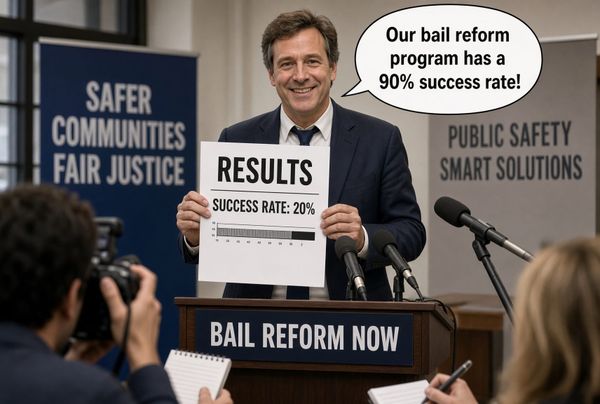
They know it doesn’t work, the research shows it doesn’t work, but they keep claiming it works
Another day, another research report comes out showing that some state’s promise of bail reform utopia never materialized. First, it was Harvard, releasing a study that showed that Arnold Ventures PSA risk assessment had ZERO predictive capabilities. Then it was an article on Illinois Safe-T-Act, showing that eliminating cash bail didn’t lead to less arrests, but rather led to more detention. And now the next shoe to drop for the bail reform movement comes out of Seattle, Washington.
For more than a decade, Law Enforcement Assisted Diversion (LEAD) was sold as the proof that pulling people out of jail and into services slashes crime and puts them to work. Cities copied Seattle. They set up programs. States wrote the model into law. And taxpayers paid. The story from the LEAD program never changed. They touted the same results and the same narrative every time: participants in the program were 58% less likely to be arrested, felony charges dropped 39%, and the odds of employment and housing soared. The problem is that wasn’t really the case.
In a recent article in the August edition of the 2026 National Retraction Brief for the Washington Policy Center, author Eric Zimmerman, points out that the claims being made by LEAD and its proponents never matched the actual data. What makes this even worse is that these misrepresentations have been used to mislead other officials across the country into implementing faulty and ineffective programs…all with taxpayer money.
If you are unaware, LEAD is a pre-booking diversion program. Officers send people involved in drug crime to case management instead of booking them. Now when the data was first released from the original University of Washington evaluations, it wasn’t easy to understand. Instead of simple percentages, they produced more complicated and vague odds ratios, to describe cuts in arrests. Those that promoted the program treated “58% reduced odds of arrest” as if it meant 58% fewer crimes, 58% fewer arrests, or a 58% drop in the chance a participant would reoffend. But it doesn’t. What it did do though is sound good. And once that swap of “odds” for “probability” and “relative change” for real-world counts was out there in circulation in the media and legislatures, it traveled. According to Zimmerman, this 58% line showed up in a wide range of different sources, including:
- Seattle Police Department
- University of Washington
- The LEAD Bureau
- KIRO News 7
- The American Journal of Public Health
- Duke Law
- The King County prosecutor
- Michigan State Police
- National Association of Counties
- The MacArthur Foundation’s video for Lisa Daugaard’s 2019 fellowship
- Albany PD
- New York health officials, and more.
When these many sources cite a piece of data or research, you can begin to see how it because credible. The problem, it wasn’t. What the results actually show is not that compelling or even statistically clean.
- On total charges, Collins et al. (2017) reported no statistically significant difference between LEAD and control over six months, and a similar picture later.
- On arrests, the unadjusted gap is about 22 percentage points—not 58%—and even that is muddied: LEAD clients appear to benefit from dropped and reduced charges that cut warrant arrests; the groups were recruited differently, policed differently, on different timelines, in different parts of the county. A clear causal drop in street arrests cannot be claimed and cannot be ruled out.
- On felonies, the unadjusted gap is about 11 points, not 39%. Study authors noted the King County prosecutor’s trial unit chief was an “unblinded operational partner” who could weigh LEAD participation when deciding whether and when to file. That is not a clean test of the program.
- Employment is the sharpest mismatch. The “46% more likely to be on the employment continuum” line does not mean people got jobs. Of 176 participants, about 13 (7%) were employed at entry; an estimated average of 16 (9%) were employed in a given month over 18 months. That is a three-person swing. Ninety-one percent stayed unemployed. The “continuum” also counted vocational training and retirement. There was no control group for that arm. Zimmerman stacks that against BLS figures for men after six months or more in prison: 34% working in week one, 50% by week ten. Different populations, he grants—but the gap is large.
- Housing is similar. “89% more likely to obtain permanent housing” describes odds, not a housing boom. Of 146 people unhoused at enrollment, an estimated 19 were housed in a typical month over 18 months—about a 13% success rate for that group. Shelter plus housing together reached about 35%. No control group. King County’s sheltered-homelessness rate barely moved in the same years. Zimmerman’s blunt reframe: LEAD may be best understood as a point-of-arrest intake valve for Housing First, not as a crime-reduction engine. About half as many participants died as the number estimated to enter permanent housing.
- Cost savings. They claimed fewer bookings, fewer jail days, lower odds of prison, an $8,061 legal-cost gap. And that data came from on groups that were not comparable in how the justice system treated them, on control-group increases more than LEAD-group improvements, and on models that lean on sunk costs and improvised measures. Zimmerman says the study does not show government saved money because of LEAD.
The stakes are not just academic. Once a program is labeled “evidence-based,” the impact cascades. Votes, RFPs, and appropriations follow the label. And everyone is brainwashed into believing the solution is viable. And then, once implemented, the public never gets to see the results. According to Zimmerman, those implementing the programs have not been reporting results to the public. They simply regurgitate the success talking points and expect everyone to just accept that.
When it comes to the criminal justice system, facts matter. Over the past decade, we have seen bail reform proponents throw idea after idea at the wall hoping it would stick. They manufacture papers, articles and research to convince others that their new-fangled program will solve all the problems in the system…and they never do. It is time to stop making public safety decisions and taxpayer investments on experimental social programs without the proper vetting and monitoring required. At the end of the day, most jurisdictions will just have to chalk LEAD up to another failed attempt to re-imagine our criminal justice system.