Strike Two: The Bail Reform Narrative Falls Short Once Again
Over the last couple months there has been two key articles published that have completely dismantled the bail reform narrative.
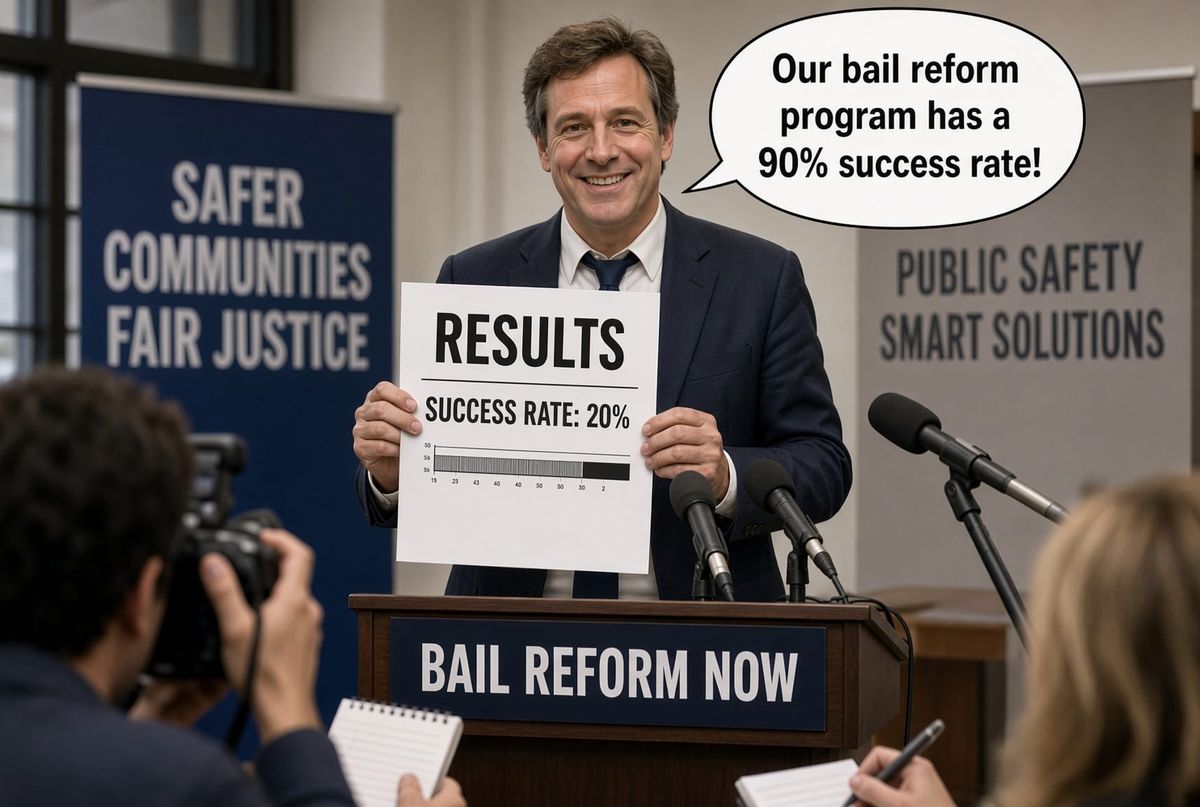
What happens when the data doesn't match what the bail reform activists say...you call them out.
Over the last couple months there has been two key articles published that have completely dismantled the bail reform narrative. The first article came from a small newspaper in Wisconsin, The Cap Times. The article completely destroyed the Arnold Ventures Public Safety Assessment. It referred to a study conducted by Harvard University that showed that the risk assessment tool, that was labeled as evidenced based and able to predict the future behavior of defendants, actually had no predictive abilities at all.
The second article came out a couple weeks ago in the New York Post. It was entitled, Criminal Justice Reform is a Bust - and Hidden Data Told the Truth All Along." In the article, the author, Ari Hoffman, argues that blue-city criminal-justice reform turned the system into a revolving door—arrest, occasional charging, then bail cuts, diversion, and “alternatives to incarceration” that put repeat offenders back on the street. New York curtailed cash bail, California leaned on diversion, New Jersey replaced much of cash bail with pretrial release, and cities nationwide copied a Seattle model sold as proof that services beat jail. That model was Law Enforcement Assisted Diversion (LEAD), launched in 2011. Boosters said participants were 58% less likely to be arrested, 39% less likely to face felony charges, far more likely to be housed, and more likely to be on an “employment continuum.” Those numbers helped Lisa Daugaard win a $625,000 MacArthur Fellowship and helped sell LEAD to Santa Fe, Albany, California, New Jersey, the Obama White House, and Congress. By 2021, 42 communities in 21 states had programs; dozens more were exploring them.
Hoffman says the public was never shown the raw results when he asked in 2019—and that a new Washington Policy Center brief by Eric Zimmerman finally does. Zimmerman found no clear difference in arrest rates between LEAD participants and a control group. About 91% of 176 participants stayed unemployed. Of 146 who entered without permanent housing, Zimmerman estimates only about 19 were housed in a typical month over 18 months. Employment among LEAD clients was about 9% in follow-up, versus BLS figures showing roughly half of men working within weeks after a stretch in prison. Santa Fe’s own three-year pilot had already reported a 41% increase in average arrests—an alarm that did not stop the model from spreading on the old Seattle claims.
Hoffman’s point is that the same “evidence-based” story underwrote New York’s 2019 bail changes and similar policies elsewhere. Zimmerman’s line is that the research never actually said what advocates claimed. Hoffman wants independent audits and public numbers on recidivism, work, housing, and mortality before taxpayers fund another round of experiments.