Congressional Testimony on Federal Bail Reform: A Misleading Portrait of Liberty vs. Reality
While his critique of wealth-based detention is a common talking point in bail reform debate and is expected from someone like Raskin, the facts about cashless bail, the federal system and their effectiveness tell a very different story.

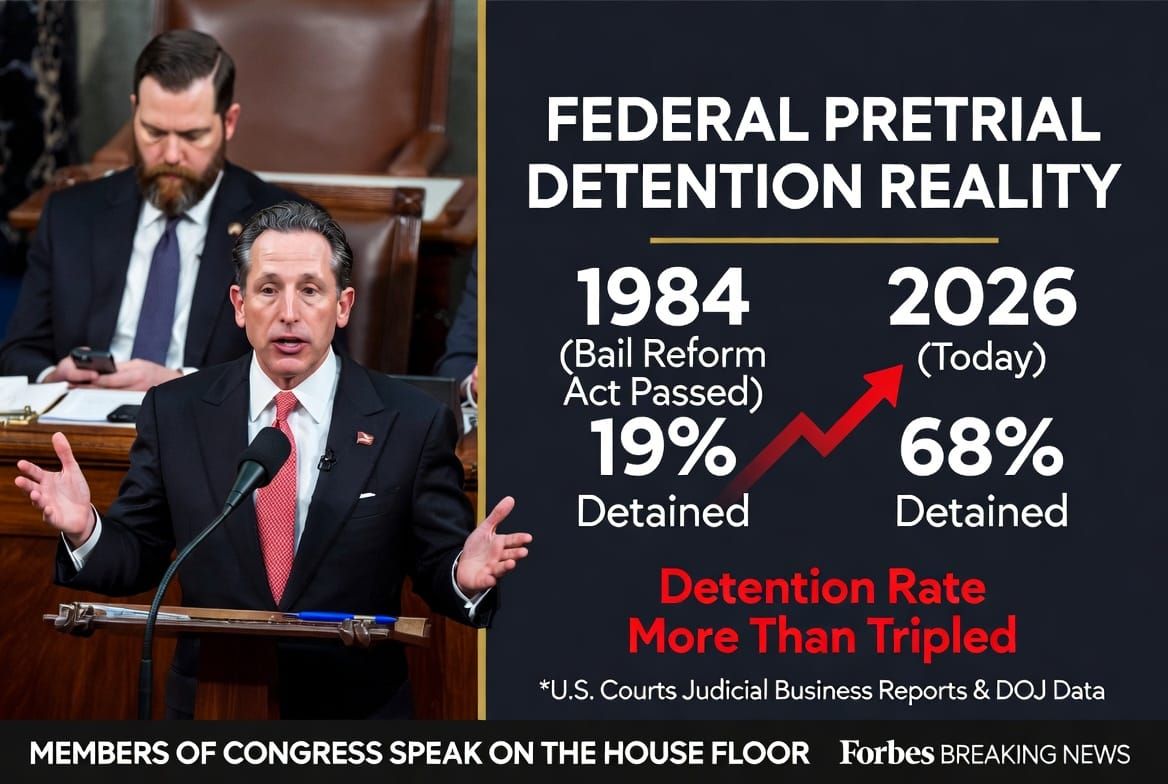
In recent congressional testimony, Rep. Jamie Raskin (D-MD) praised the federal pretrial system as a model of “liberty and freedom.” He argued that the federal approach, which consists of a cashless bail system that uses risk-based assessments focused solely on danger to the community or flight risk, proves that cashless pretrial release works. Raskin contrasted this with state systems that still use financially secured bonds. He also demonized the surety bail industry as an evil for profit business. While his critique of wealth-based detention is a common talking point in bail reform debate and is expected from someone like Raskin, the facts about cashless bail, the federal system and their effectiveness tell a very different story.
Over the past several decades, the federal pretrial system has become overwhelmingly a system of detention, not liberty. When Congress passed the Bail Reform Act of 1984 (which was built on the 1966 Act and introduced preventive detention for dangerous defendants), roughly 81% of federal defendants were released pretrial. Detention rates hovered around 19%. Today, the picture is dramatically reversed. According to the most recent U.S. Courts Judicial Business reports (FY 2025), only 32% of federal defendants are released pretrial when immigration cases are excluded — meaning 68% are detained. Including immigration cases, the overall release rate drops to just 20%. Multiple analyses confirm this trend: by 2019, pretrial detention had reached 74.8% in some federal districts, with defendants often held for months. Does Raskin even know what he is supporting? The federal “cashless bail” experiment has not produced a fairer system. It has instead produced a system of detention where people who have been accused of a crime can sit for months awaiting trial. If this system were adopted nationally at the state level, our jails would not be able to handle the volume of people who would be held with no option for bail.
Despite Raskin’s uninformed testimony, financially secured release through commercial surety bonds remains the most fair and effective mechanism for ensuring court appearance while protecting public safety. Landmark studies, including the Bureau of Justice Statistics’ Cohen & Reaves (2007) national analysis and the peer-reviewed Helland & Tabarrok (2004) economic study consistently show that surety bonds achieve the lowest failure-to-appear rates (often 17–18% vs. 26–30% for unsecured or recognizance release) and superior fugitive recovery. The private financial incentives placed on defendants, bondsmen, and sureties outperform both unsecured release and taxpayer-funded pretrial supervision. States should reject the federal model’s drift toward mass detention and instead preserve proven, incentive-driven surety bonds that balance liberty, accountability, and public safety without burdening taxpayers.
Watch Senator Raskin's testimony by clicking on the link below...
(https://www.youtube.com/watch?v=_VkmUFkVMH8)