Charitable Bail's False Narrative and Why It’s so Irresponsible and Dangerous
In a recent opinion piece, the national policy director for The Bail Project, argues that cash bail punishes people simply for being poor and that charitable bail funds offer a more humane and effective alternative.
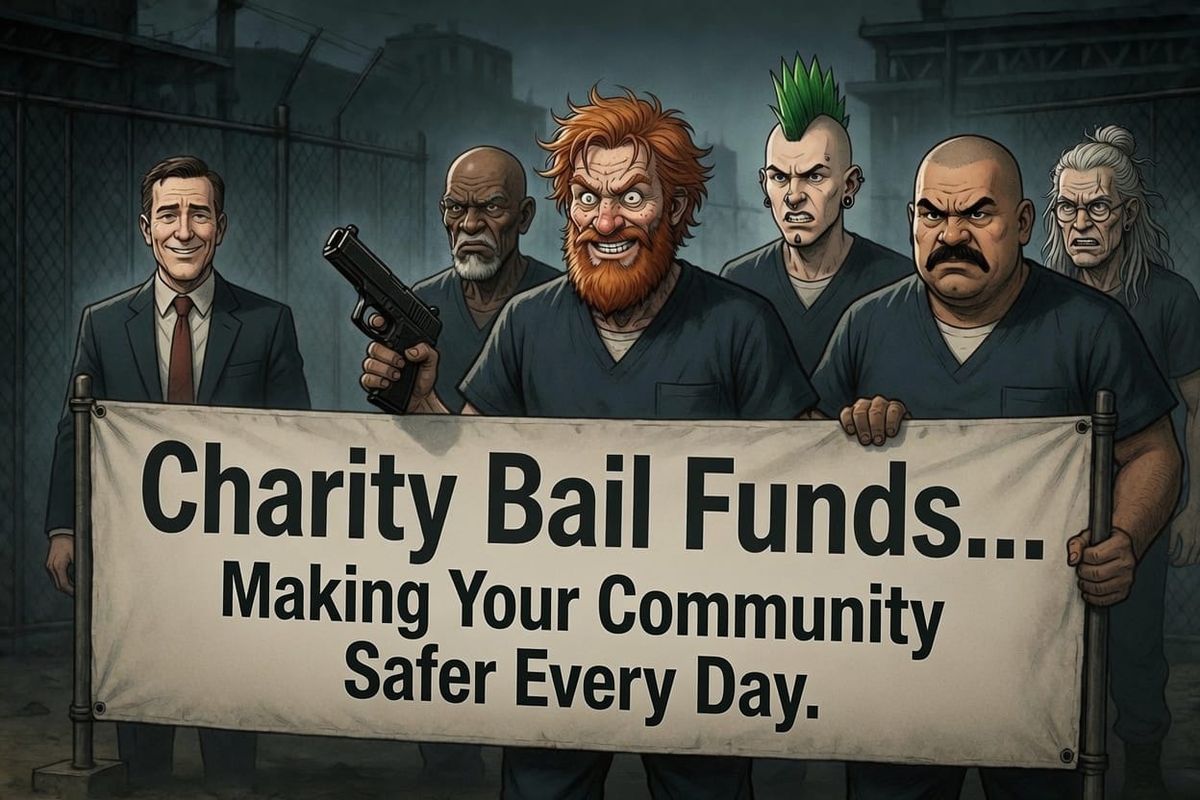
In a recent opinion piece (Cash bail is how criminal justice punishes poverty | Opinion), Erin George, national policy director for The Bail Project, argues that cash bail punishes people simply for being poor and that charitable bail funds offer a more humane and effective alternative. While her piece frames cash bail as an arbitrary financial barrier, it conveniently ignores several critical realities about how the current system works and why commercial surety bail continues to play a vital role in ensuring accountability.
George claims that cash bail is unnecessary because The Bail Project has achieved a 92% court appearance rate among the people it assists. However, this figure should be viewed with significant skepticism. The way The Bail Project calculates and reports its appearance rate is questionable (The Misleading Pretrial Numbers Game). When a defendant misses one court appearance out of ten, the Bail Project will call that a 90% appearance rate. In the criminal justice system, when a defendant misses one court appearance, it is not a 90% appearance rate, it is a 0% appearance rate. Defendants are required to attend ALL court dates, not just the ones they and the Bail Project feel are important. So, when a defendant makes nine out of ten court dates and misses only one, that is NOT a 90% appearance rate. That is a false success narrative being spread by the Bail Project and other bail reform advocates. By using this type of fuzzy math and false success narrative, the Bail Project is claiming effectiveness and success. They use this false narrative to then justify their releasing of potentially dangerous people into the public, and they do so without fully understanding the individual’s criminal history and background. And it doesn’t take a rocket science to see that approach does not make us safer or make the system fairer. It in fact does the complete opposite.
Additionally, there have been multiple documented cases across the country where individuals released through charitable bail funds — including those supported by organizations like The Bail Project — have gone on to commit new crimes while awaiting trial (https://www.aiasurety.com/bail/charitable-bail-funds-latest-dangerous-bail-reform-idea/). These incidents undermine the claim that removing financial accountability has no impact on public safety or court compliance. When there is no skin in the game and no professional assessment of risk, the system loses one of its most effective tools for ensuring defendants return to court.
This problem is further illustrated by the troubling philosophy embraced by some charitable bail organizations. In a widely circulated video (https://youtu.be/V2amfLkZd3Q?si=wlJ80pva9A-2GNOE), the former head of the Minnesota Freedom Fund openly declared “f*** the police and f*** the courts.” This kind of anti-accountability rhetoric reveals a deeper issue: some of these groups are not simply trying to help poor defendants navigate the system — they are actively working to undermine it. When organizations that pay bail hold such hostile views toward law enforcement and the judicial process, it raises serious questions about whether their model prioritizes justice or seeks to weaken it. Click on the following link to see more reporting on the dangerous individuals released by charitable bail funds (https://www.fox9.com/news/minnesota-nonprofit-with-35m-bails-out-those-accused-of-violent-crimes).
Commercial bail agents, by contrast, operate under strict state licensing requirements and have a direct financial incentive to ensure defendants appear in court. They conduct thorough underwriting, often requiring collateral and co-signers, and they actively monitor their clients. If a defendant fails to appear, the bail agent stands to lose the full amount of the bond. This private-sector accountability is fundamentally different from a charitable model that bears no financial risk when someone reoffends or disappears.
George also suggests that most people in jail are there for minor, non-violent offenses. While it is true that many jail admissions involve lower-level charges, this framing ignores the fact that many of those same individuals have prior criminal histories or are facing multiple charges. Judges set bail based on a range of factors, including public safety and flight risk, not simply to punish poverty. We are pretty sure that we have never seen anyone arrested and accused of a crime because of the amount of money in their wallet.
The most straightforward way to avoid having to pay bail is also the most obvious: don’t commit a crime. The criminal justice system is not designed to be a frictionless experience for those accused of breaking the law. While no one should be held in jail solely because they are poor, completely removing financial accountability and professional risk assessment in favor of unregulated charitable bail funds is not a serious solution. It is an ideological experiment that often prioritizes ideology over public safety and court integrity.
Financially secured bail is not perfect, but no system is. That being said, it still remains one of the most tried and tested systems in existence that combines financial responsibility with professional oversight. Dismantling bail in favor of models that lack both is a step backward, not forward.