Will Washington State's Supreme Court Listen to the People or One Special-Interest Group?
The proposed rules would make it significantly harder to detain defendants who miss court dates and would cap bail amounts for many low-level offenses.
To Say That There is a Public Outcry Over Washington’s Proposed Pretrial Release Rules Would be an Understatement
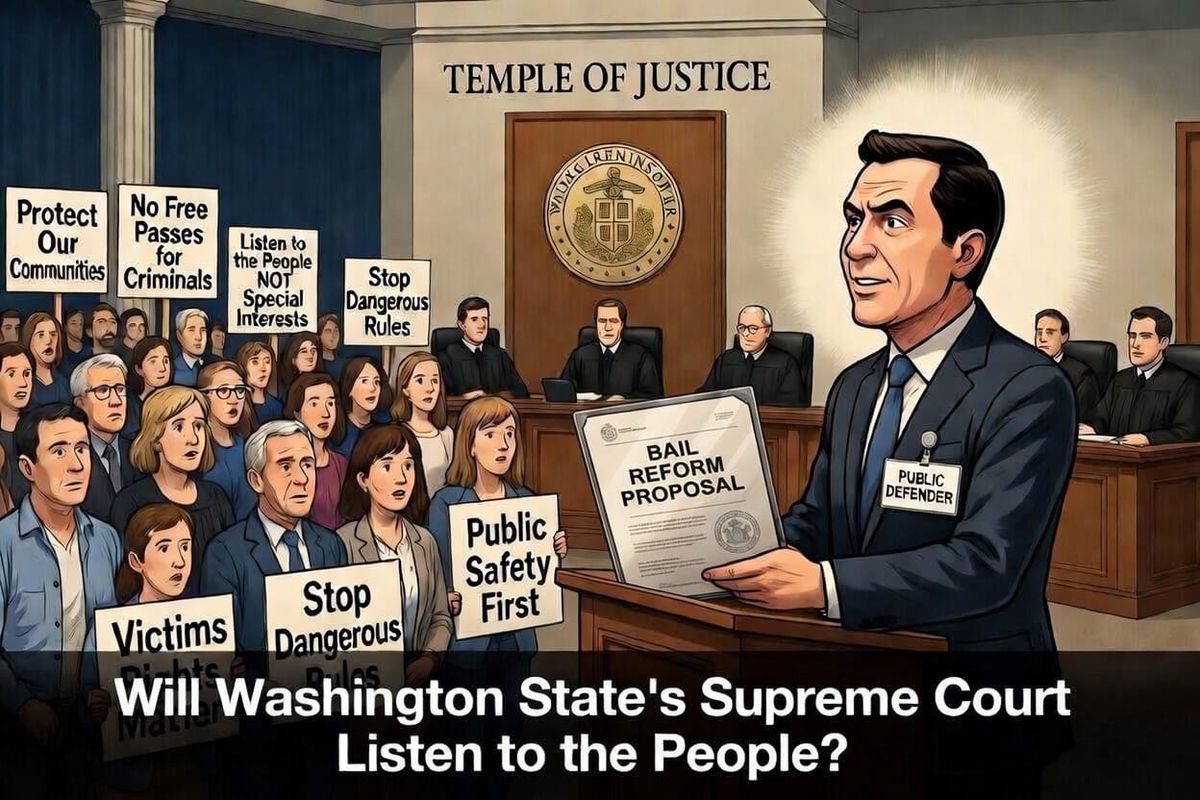
Washington State’s Supreme Court is currently considering sweeping changes to the state’s criminal court rules. The proposed rules would make it significantly harder to detain defendants who miss court dates and would cap bail amounts for many low-level offenses. The proposal, identified internally as Order No. 25700-A-1676 and tied to amendments to CrR 3.2, CrRLJ 3.2, CrR 2.2, and CrRLJ 2.2, has drawn an avalanche of public comments on the official court website and the overwhelming majority are fiercely opposed.
What the Proposal Would Do
The changes were proposed by public defender organizations, including the King County Department of Public Defense, the Snohomish County Public Defense, the Washington Office of Public Defense, and allied groups. Their stated goal is to reduce “wealth-based” pretrial detention for misdemeanor and low-level felony defendants.
Key provisions include:
- Raising the standard for issuing an arrest warrant after a failure to appear from a “likely risk of nonappearance” to a much higher bar: a “high likelihood of willful flight” with proof of intentional conduct to thwart justice. A single missed court date would no longer be enough on its own.
- Capping bail at $200 for most misdemeanors, property crimes, and drug offenses.
- Creating a strong presumption that defendants can post just 10% of the bail amount directly with the court clerk instead of paying full bail or using a bail bondsman.
Proponents argue these reforms would cut unnecessary jail time, address racial and economic disparities, and align with research showing that low-level defendants often appear without heavy financial pressure.
The Public’s Overwhelming “No”
Anyone visiting the public comment page for Order No. 25700-A-1676 will see more than 350 submissions, the vast majority strongly against the proposal. Commenters include crime victims, victims’ rights organizations such as Crime Survivors and Crime Victims United, former prosecutors (including the former Sacramento County District Attorney Anne Marie Schubert), bail industry professionals, rank-and-file citizens, and a bipartisan group of more than 40 Republican state legislators.
Common themes in the opposition:
- Public safety and repeat offenders: Many argue the changes amount to a “free pass” for defendants to skip court without serious consequences, leading to more failures to appear, more reoffending, and more danger to communities.
- Data from pilot programs: Opponents point to past experiments in Washington and other states showing failure-to-appear rates rising 15–35% under similar lenient policies.
- Burden on law enforcement and courts: Re-arresting people who ignore summonses wastes police time and taxpayer dollars.
- Victims’ rights ignored: Families of victims say the rules prioritize defendants’ convenience over accountability and closure for those harmed.
- Separation of powers: Dozens of comments insist that major criminal justice policy changes like these should be made by the Legislature, not imposed by judicial rule. Lawmakers called it an overreach that bypasses the democratic process.
Typical sentiments from the comment page include warnings that the rules would “endanger communities by prioritizing release over accountability,” “erode judicial discretion,” and “devastate victims and families” by making it harder to enforce court orders.
Media coverage has amplified the backlash. Conservative commentator Jason Rantz and others have labeled the proposal a gift to repeat offenders that weakens the justice system’s ability to ensure defendants show up. Social media and local news have featured stories of victims and law enforcement expressing frustration that the courts appear poised to tie their own hands.
A small number of comments support the changes, mostly from defense attorneys, law students, and criminal justice reform advocates, but they represent a clear minority on the public record.
The Big Question Facing the Washington Supreme Court
The nine justices now face a stark choice: adopt a rule pushed hard by one powerful stakeholder group, public defenders and their allies, or heed the loud, consistent voice of the broader public that flooded the comment portal with concerns about safety, victims, and accountability.
Will the Washington Supreme Court do what one stakeholder group wants, or will it decide based on what the people want?
The answer will reveal whether the state’s highest court views its rule-making authority as a tool for listening to everyday Washingtonians — or as a shortcut for implementing the policy preferences of a narrow slice of the criminal justice bar. With public safety, victims’ rights, and taxpayer resources on the line, the eyes of the state are on Olympia.
The comment period closes April 30, 2026. Comments can be submitted to the Clerk of the Washington State Supreme Court.
Email your letter to:
supreme@courts.wa.gov
In the subject line include the following:
Letter of Opposition to Proposed Amendments to
CrR/CrRLJ 3.2 (Release of the Accused) and CrR/CrRLJ 2.2
(Warrant of Arrest and Summons) – Order No. 25700-A-1676