The Purpose of Bail has Never Been About Money or Punishment, but Rather a Restraint on Government Power

When most people think of the topic of bail bonds they typically default to the narrative and opinions that are presented by the opponents of bail. Why? Because these often misguided and one-sided opinions are the only points of view that Google’s algorithm decides to share. The challenge is that there are many thoughtful and alternative viewpoints on topics such as bail reform, cashless bail and pretrial release, that people have that are not being served up and presented by Google. These viewpoints are much harder and are much more difficult to find.
An example of one of these viewpoints is the recent article from Mike Morrison, President of the Mississippi Bail Agents Association. In his article, Mr. Morrison argues that traditional bail doesn’t serve as punishment as the bail reform supporters often claim, but rather, surety bail serves as a crucial, practical check on government power at the local level. Drawing from personal experience in the criminal justice system, Mr. Morrison contends that bail is not merely a policy issue or a loophole but a fundamental restraint against unchecked authority. This understanding emerges not from theoretical debates but from observing how procedures evolve and how liberty can erode quietly when oversight lapses, particularly under cashless bail models that prioritize release without financial accountability. The piece emphasizes that bail's true purpose—to balance accountability with freedom—remains vital in preventing abuses of pretrial detention, countering the risks associated with widespread bail reform initiatives.
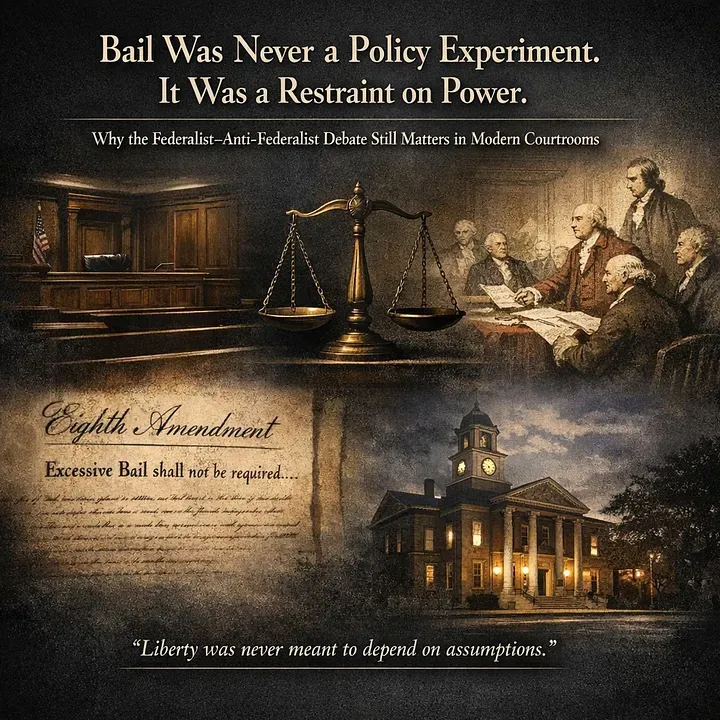
Historically, bail's origins trace back to the founding era, highlighting the divide between Federalists and Anti-Federalists—a tension that echoes in today's discussions on bail reform and the push for cashless bail. Federalists prioritized order and trusted existing legal traditions, including English common law's prohibition on excessive bail, to naturally limit power without explicit enumeration. In contrast, Anti-Federalists, haunted by experiences under distant rule, distrusted concentrated authority and insisted on explicit safeguards. Their skepticism about pretrial detention as the most perilous government power—potentially used for leverage rather than necessity—pressured the inclusion of the Eighth Amendment's protection against excessive bail in the Bill of Rights. This shift moved accountability from the state to the community through financially secured sureties.
In the modern context of 2026, bail agents are the living continuation of this community-based accountability, standing in the tension between liberty and responsibility that the Founders intended. Professional bondsmen enforce real consequences for failures to appear, unlike impersonal risk assessments or unsecured releases under cashless bail, which are forms of centralization that erode human judgment and increase issues like non-appearances and diminished public trust. Ultimately, the traditional bail profession endures not only because it stems from hard-won distrust of state power alone, but because it is effective. It is effective at balancing the system so that the accused can be free to prepare for their case and the victim can have a chance at justice when the accused shows up for court. Instead of trying to eliminate bail, decision makers should try to understand its importance and its role. And that role is foundational to preserving freedom through practical, localized checks rather than relying solely on good intentions or bureaucratic systems pushed by bail reform and cashless bail proponents.
See a brief section of Mike’s article below as well as a link to the full article.
Bail was never a Policy Experiment
by Mike Morrison
After a lifetime inside the criminal justice system, you stop thinking about bail as a policy debate and start recognizing it for what it actually is: one of the last remaining, practical restraints on government power that still operates at the local level. That realization doesn’t come from books or conferences. It comes from years spent watching courts change, watching procedures shift, and watching how easily liberty can be narrowed when no one is paying attention. CLICK HERE TO READ THE FULL ARTICLE




Member discussion