The Prison Policy Initiative's War on Crime Victims

Why is PPI on a mission to glorify criminals and diminish the voice of victims of crime
According to its website, The Prison Policy Initiative (PPI) is a non-profit, non-partisan organization that produces cutting edge research to expose the broader harm of mass criminalization and then sparks advocacy campaigns to create a more just society. For years, this so called “non-partisan” group, and its broad network of other like-minded activist organizations have organized and focused their efforts on promoting bail reform, cashless bail and anti-crime victim policies. They have produced research papers and written dozens of articles about how tough-on-crime policies are ineffective and how unaccountable soft-on-crime policies are better. What is always shocking about the Prison Policy Initiative’s research and articles is that they never align with common sense or even facts.
Recently, PPI released another propaganda report. This latest report is called “Mass Incarceration: The Whole Pie in 2026.” The report contains a list of what they call “10 myths about crime and mass incarceration.” The first six myths are exactly what you would expect:
MYTH #1:
Crime is up and immigration and criminal legal system reforms are to
MYTH #2:
Releasing “non-violent drug offenders” would end mass incarceration
MYTH #3:
By definition, “violent crime” involves physical harm
MYTH #4:
People in prison for violent/sexual crimes are too dangerous to be released
MYTH #5:
Some people need to go to jail to get treatment and services
MYTH #6:
Harsh punishments deter crime
Now, we will cover all these myths in more detail in another series on the Myths of Bail Reform, but for purposes of this article I want to focus on Myth #7.
MYTH #7:
Crime victims support long prison sentences
This myth is what really got our blood boiling. To be honest, it is not just this one thing, but rather the gradual movement that we have all seen happening in our criminal justice system. Specifically, within the victims' resources, services and funding components of the system. For years, we have watched the progressive billionaire funded activist groups force a narrative on our culture that the people accused of the crime are the real victims in society. In the process they have successfully minimized the system’s focus on the actual crime victim. No longer is there adequate funding or support for victims of crime. Instead, the narrative has pushed the funding towards the “new” victim in the criminal justice system, the accused. Below are the results of their survey on “What Crime Victims Really Want” that they included as support for Myth #7.
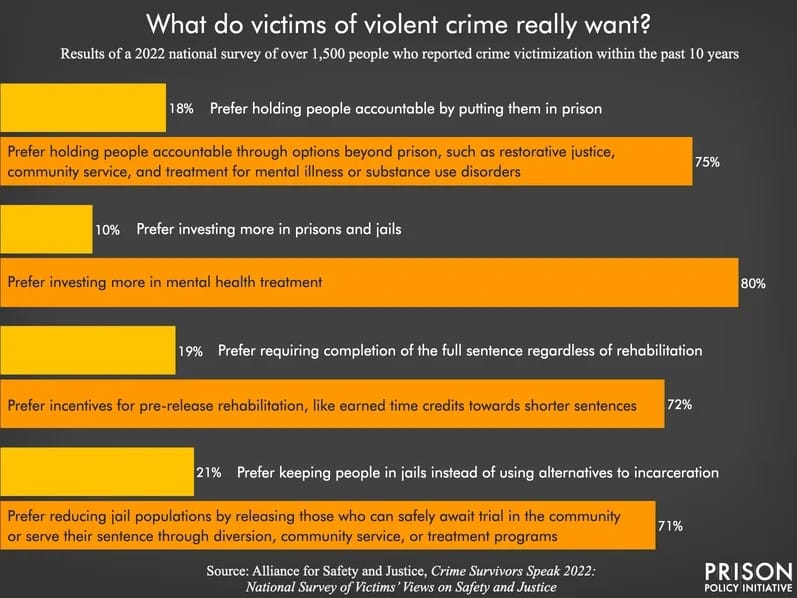
This chart is a perfect example of how activist groups like PPI change the narrative in the criminal justice system. They make outrageous claims, and then back them up with charts like the one above. Charts that are obviously fabricated for impact. We are not sure what actual crime victims they got to take this survey, and which ones would ever respond in the way that these charts indicate, but we are sure the results are wrong. Just to double check, we forwarded this chart on to Patricia Wenskunas from the victim advocacy group, Crime Survivors. When she saw the chart, she about lost her mind. She let me know that from a crime victims’ perspective, not a single one of the results was believable or possibly true. Just as we had, she immediately could see that this chart was not about facts or real research, but rather about more propaganda shifting the narrative away from the real victims.
This is the challenge that our communities have. These are the types of communications that these well-funded and organized activist groups are producing. These are the types of misinformation that they are using to convince elected officials to support soft on crime policies. These are the types of propaganda they are using to shift the money and resources to their criminal support groups away from real victim support groups. We all must work together to aggressively challenge these types of false and misleading reports. We all must work together and educate both the public and our elected officials that these are not the types of policies that we want. They do not keep our communities safe, and they do not bring justice to victims of crime.
If you want to learn more about Crime Survivors and what you can do to help them fight against this misinformation and propaganda, visit their website and donate, www.crimesurvivors.org.




Member discussion