The Importance of Going to Court: What the Prison Policy Institute overlooks in their latest report on court appearances

The sole purpose of any pretrial release mechanism is to ensure the appearance of the defendant in court. And that “appearance” doesn’t mean you have to attend one court appearance or only the convenient court appearances, it means you must attend ALL court appearances. Why is it that cashless bail and bail reform proponents don’t understand that concept. It is actually pretty simple. When a defendant who is accused of a crime misses court, there is no court case that day. That means resources were wasted, time was wasted, money was wasted and worst of all, victims didn’t get their day in court and a chance at justice. Also, when a court appearance is missed, the defendant is violating the conditions of their release. In other words, breaking the law.
According to a recent article from the Prison Policy Initiative, missing court should not be something for which people should be penalized. Especially not jail. PPI reports that 1 out of 8 jail bookings are connected to a failure to appear and not something more serious. Annually, that means approximately 1,033,000 people are in jail because, according to PPI, they “simply” missed a court date. PPI believes that missing court is not something that is that serious. They believe that people should be able to just reschedule a missed court date like they do when they miss a dentist’s appointment. Only if it were that simple.
Here is the problem with that kind of thinking. Missing a court date and missing a dentist’s appointment are not the same thing. The most important and sometimes the only criteria that a defendant has when they are released pretrial is their promise to show up for court. When someone misses a court date, they are violating that promise. Our criminal justice system is based on responsibility and accountability. When a crime is committed there needs to be both. But if PPI was in charge there would be neither.
The other thing that PPI is not considering, is that over the past decade the cashless bail and soft on crime policies that they and their partner bail reform organizations have had an enormous impact on the number of “failure to appears” (FTAs) in the criminal justice system. When people are released on cashless bail or personal recognizance bonds instead of financially secured surety bonds, they are much more likely to fail to appear for court. In fact, Harris County, Texas (Houston) is a great example of this. After the use of PR bonds exploded, FTAs followed. According to the website Harris County Court Watch (https://harriscountycourtwatch.com/home), the average FTA rate across all of Harris County’s criminal courts was over 80%.
If PPI wants to end people being incarcerated for FTAs, maybe they should stop the increase in FTA’s first. That means eliminating soft on crime cashless bail policies and instead focus on more effective methods like surety bonds.
Below is an excerpt from the findings in PPI’s latest report.
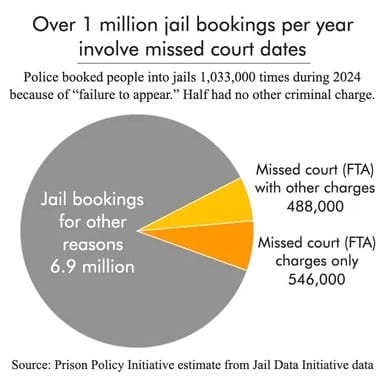
How many jail stays are due to missed court dates?
Failing to make it to a court appearance – routine for attorneys and witnesses – leads to 19 million additional nights in jail each year for people accused of crimes.
By The Prison Policy Initiative
In new data from 562 jails, we find that more than 1 in 8 jail bookings (13%) are related to a failure to appear (FTA), and more than half of those are FTA only. That may not sound like many, but because so many people cycle through jails annually, these numbers add up quickly: Across the United States each year, there are around 1,033,000 jail bookings involving people facing FTA charges (either alone or alongside other criminal charges). Roughly 546,000 — or over half — of those jail bookings are due only to a failure to make it to a court appearance.




Member discussion