PART 5: The Business of Bail Reform - Who Profits When Commercial Bail Dies
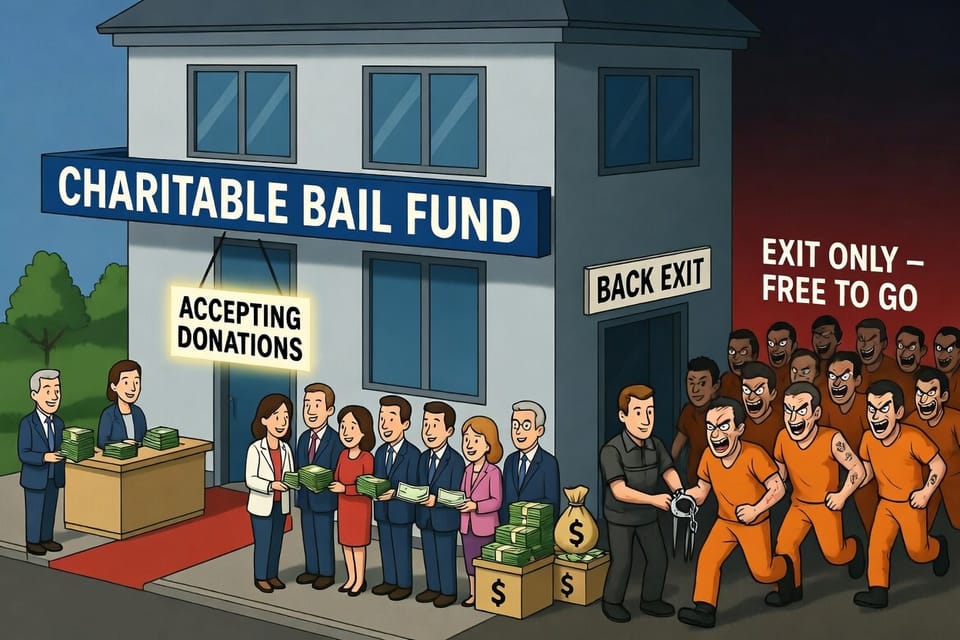
Charitable Bail Funds Collected $90 Million in 2020 While Clients Committed Murder
by JL Fullerton
During the 2020 George Floyd protests, approximately $90 million flowed to bail funds nationwide ($75 million through the National Bail Fund Network). The Bail Project received $15-16.5 million and holds $68.5 million in assets as of 2024. CEO David Gaspar stated directly: "Our goal was to end cash bail." These charitable bail funds marketed themselves as a mechanism by which peaceful protestors could be bailed out. Unfortunately, what ended up happening was that these charitable bail funds didn't just bail out protestors...they bailed out anyone they could for any crime. It didn't matter to them what the charges were or what was the criminal history of the defendant. According to the leadership of the Minnesota Freedom Fund, it was a giant "F-you" to the police and a giant "F-you" to the courts. A much different message than donors received.
Once the media started looking into who these bail funds were actually releasing with people's donations, the truth and the associated human cost became tragically apparent:
- Samuel Scott (Kentucky, 2019): The Bail Project paid $5,000 bail on a domestic violence charge. After release, Scott beat his wife to death.
- Marcus Garvin (Indiana): Bailed out by TBP on stabbing charges, later murdered his girlfriend, Christie Holt.
- George Howard (Minnesota): Minnesota Freedom Fund posted $1,500 for a domestic violence charge; Howard later committed second-degree murder in a road-rage shooting.
- Darnika Floyd (Minnesota): MFF posted $100,000 bail; Floyd later charged with second-degree murder for stabbing a friend.
- Christopher Boswell (Minnesota): Twice-convicted rapist bailed out for $350,000; charged with kidnapping and sexual assault in two separate cases.
A CNN investigation found that in Hennepin County alone, at least 65 defendants bailed out by the Minnesota Freedom Fund while facing felony charges involving violence, threats, or sex crimes were later convicted. The investigation documented failure-to-appear rates of 42% for MFF defendants versus 22.5% for commercial bail. The Northwest Community Bail Fund in Seattle showed a 52% FTA rate versus 24% for traditional bail. And remember, these charitable bail funds were supposed to be bailing out peaceful protestors.
Unlike commercial bail agents—who must obtain state licenses, submit to background checks, maintain surety bonds, and bear financial consequences when defendants flee—charitable bail funds operated with no licensing requirements, no state oversight of who receives bail, and no accountability mechanism for failed appearances until Indiana passed HEA 1300 in 2022, upheld by the Seventh Circuit Court of Appeals.
So, the next time you see charitable bail funds raising money, you should take a step back and think twice before just donating your hard-earned money. Ask yourself, who is funding this group? Who is behind this group? Who is this group actually bailing out? And why does this group want to end the bail profession? Because your donation just might be funding a different cause than you think and the next person that gets bailed out might just be dangerous repeat offender accused of a violent crime.
Stay tuned for the next article in the Business of Bail Reform Series, Part 6: Drug Testing Providers Secured Millions as Requirements Expanded
Read other articles in the Business of Bail Reform series…
Part 2: When Private Prison Companies Promote Bail Reform, Follow the Money
Part 3: The Electronic Monitoring Industry Found its Growth Engine
Part 4: Risk assessment tools cost nothing upfront but extracted a different price


Member discussion