PART 4: Washington Bail Reform
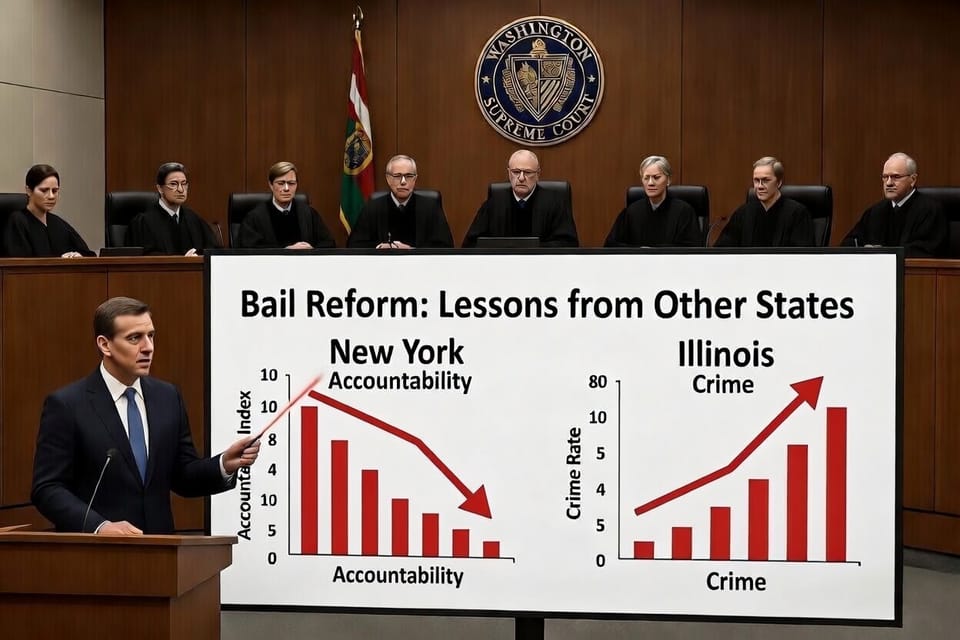
If Bail Reform Failed in New York and Illinois, Then Why is Washington's Proposed Court Rules Citing Them as Models to Follow
By JL Fullerton
The next article in the 5-part Washington State bail reform series takes a look at New York and Illinois. Both of these states are cited as examples of successful bail reform in the court rules proposal submitted to the Washington State Supreme Court. But if you look at the actual results and crime data coming out of both of those states, "success" might not be the word you would choose to describe them.
Part 4: New York Rolled Back Its Bail Reform Three Times. Illinois FTA Rates Spiked. Washington Calls Them Models.
The proposed overhaul of Washington State's bail rules cites New York and Illinois as jurisdictions that have successfully reformed their pretrial systems. But a closer look at what actually happened in both states tells a more complicated story – one the proponents chose not to share with the Court.
New York: Three Rounds of Corrections
New York passed landmark bail reform in 2019, eliminating cash bail for most misdemeanors and nonviolent felonies. The law took effect on January 1, 2020.
Within weeks, crime data in New York City showed sharp increases. A Manhattan Institute analysis found that index crimes rose 20 percent in the first two and a half months after the reform took effect. Burglaries increased 26 percent. Car thefts jumped 68 percent. Grand larceny rose 16 percent. These increases occurred in the specific crime categories where judges could no longer set bail.
Researchers have debated whether bail reform itself caused these increases or whether the COVID-19 pandemic, which hit New York hard just months later, was the primary driver. A Justice Quarterly study by SUNY Albany researchers found that when pandemic effects were controlled for, the crime increases were not statistically significant – though the researchers noted limitations in their methodology. The New York City Comptroller's office reported that pretrial rearrest rates climbed, though slightly, between 2019 and 2022, while average bail amounts for remaining bail-eligible charges nearly doubled.
Whatever the academic debate, the political response was clear: New York's legislature concluded its own reform went too far. The law was amended in 2020, adding more than two dozen new bail-eligible charges. It was amended again in 2022, further expanding judicial discretion. It was amended a third time in 2023. Each round of changes walked back portions of the original reform in response to public safety concerns.
The Washington proposal cites New York as a model without mentioning any of these three rollbacks.
Illinois: FTA Summonses Exploded
Illinois eliminated cash bail entirely in September 2023 through the Pretrial Fairness Act , part of the broader SAFE-T Act. The Washington proposal cites Illinois's "willful flight" standard as the model for its own proposed language.
County-level data from Illinois paints a mixed picture at best. McHenry County – one of the jurisdictions tracking post-reform data in detail – reported several concerning trends:
The rate of defendants charged with new offenses while on pretrial release rose from 7.8 percent before the reform to 10.1 percent after.
FTA patterns shifted dramatically. Before the reform, the court issued 1,055 FTA warrants and 1,433 FTA summonses in a six-month window. After the reform, in a comparable period, the court issued 616 FTA warrants but 8,845 FTA summonses. The court was not handling fewer failures to appear – it was handling them differently, with far more administrative burden.
Crime victim restitution payments dropped from $342,160 to $254,411 as bail-funded restitution dried up.
McHenry County noted that before the reform, 97 percent of defendants were already being released pretrial under the existing cash bail system – undermining the premise that massive reform was needed.
An Illinois Policy Institute analysis of the first year found that downstate Illinois counties reported significant difficulties adjusting, with fewer resources to manage increased petition filings and a surge in appeals. The gap between how Cook County applies the law and how other counties apply it has been striking – Cook County prosecutors sought detention in only 19 percent of eligible cases, while the statewide average was 60 percent, suggesting wildly inconsistent implementation.
What This Means for Washington
The proponents present these states along with Vermont, as proof that bail reform works. But New York's legislature felt compelled to amend its own law three separate times. Illinois counties are reporting increased pretrial reoffending rates and massive increases in FTA-related court activity, and Vermont had to roll back its $200 cap on misdemeanor bonds. None of those jurisdictions have produced a clean success story.
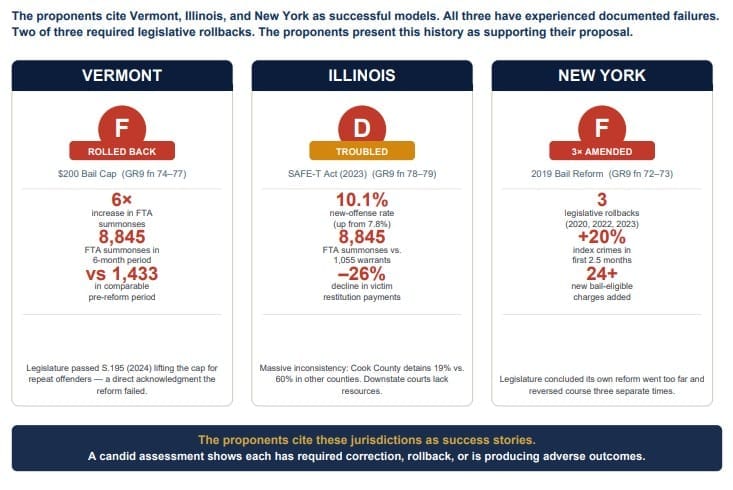
Washington is being asked to adopt elements of all three models – Illinois's willful flight standard and a Vermont-style bail cap – without any acknowledgment that the jurisdictions these ideas came from have already experienced significant problems.
The comment period for these proposed rule changes runs through April 30, 2026. Comments can be submitted to the Clerk of the Washington State Supreme Court.
Email your letter to:
supreme@courts.wa.gov
In the subject line include the following:
Letter of Opposition to Proposed Amendments to CrR/CrRLJ 3.2 (Release of the Accused) and CrR/CrRLJ 2.2 (Warrant of Arrest and Summons) – Order No. 25700-A-1676
Read Parts 1 - 3 of the 5-article series as well as other articles on the topic:




Member discussion