PART 3 of 5 - Washington State Bail Reform
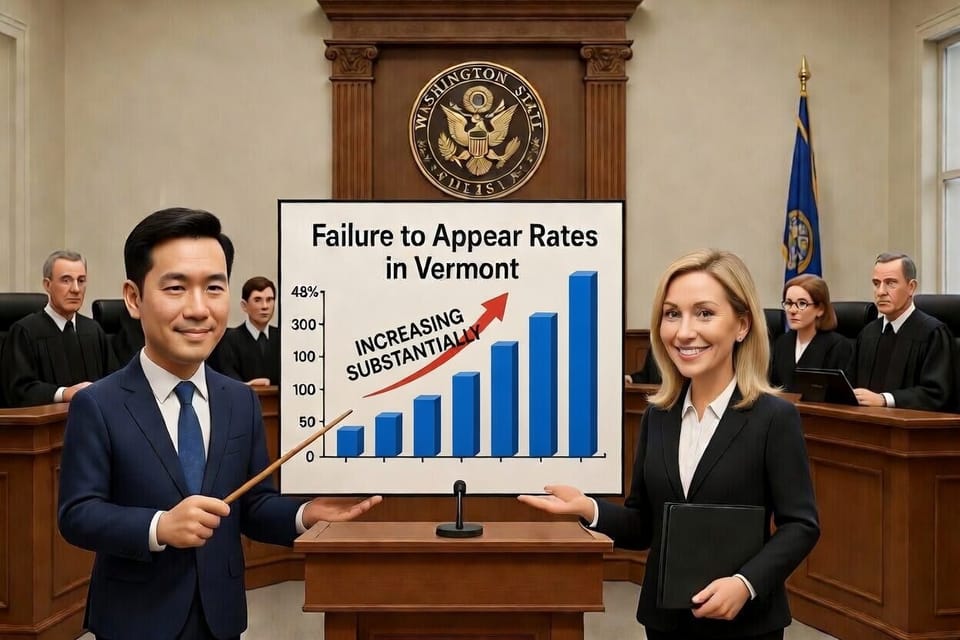
Why is Washington State's Supreme Court Considering Following Vermont's Failed Pretrial System That was Eventually Rolled Back?
By JL Fullerton
This next article is part 3 of the five-article series by JL Fullerton discussing Washington State's new proposed court rules. In this next article, Mr. Fullerton digs into the $200 bail cap for misdemeanors policy from Vermont that Washington State is now considering based on the proposed rules. The problem is that Vermont's $200 bail cap policy failed miserably. So, the question becomes, why in the world would Washington State consider such a substantial rule change based on a failed Vermont policy?
Part 3: Vermont Had a $200 Bail Cap for Misdemeanors. It Had to Be Rolled Back. Now Washington Wants to Copy It.
A proposal before the Washington State Supreme Court would cap bail at $200 for most misdemeanor offenses. The proponents point to Vermont as their model. What they do not mention is that Vermont already tried this — and the state legislature had to step in and fix it because it was not working.
Vermont enacted a $200 bail cap for certain misdemeanor offenses in 2018. The idea was similar to what is now being proposed in Washington: keep bail amounts low to reduce pretrial detention of people who cannot afford to pay.
Within a few years, Vermont law enforcement and prosecutors began reporting serious problems. Defendants were cycling through the system– violating conditions of release, failing to appear in court, committing new crimes, getting arrested on warrants, and then being released again. State's Attorney offices described it as a revolving door.
The data backed up those concerns. Vermont legislative testimony presented to the House Judiciary Committee showed a dramatic increase in failure-to-appear activity after the reform. In one six-month period, courts issued 8,845 FTA summonses – compared to 1,433 in a comparable period before the reform. That is a more than sixfold increase.
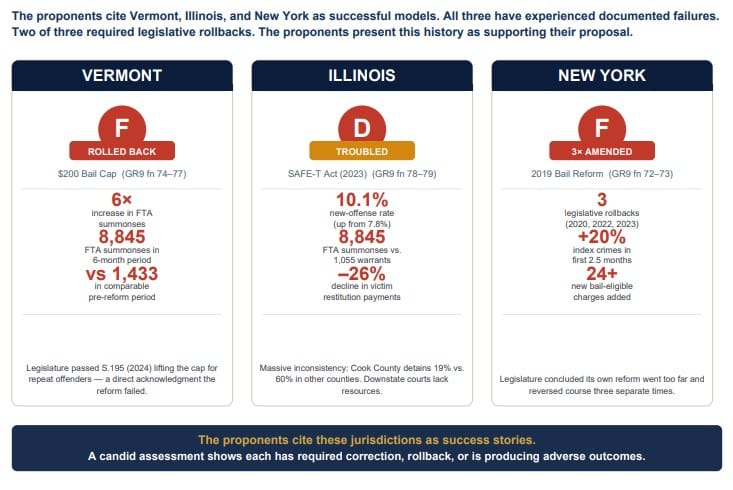
In 2024, the Vermont legislature passed Senate Bill S.195 to address the problem. The new law lifted the $200 cap for defendants who are charged with a new crime while already out on pretrial release for another offense. The legislature also created a pretrial monitoring program and expanded the use of electronic monitoring– steps that acknowledged the original reform had removed accountability without replacing it. The ACLU of Vermont opposed the bill, calling it a step backward, but it passed anyway.
In 2025, Vermont legislators went further. House Bill 409 was introduced to allow judges to revoke bail for non-violent offenders who continuously violate conditions of release, fail to show up for court, or violate court orders. News coverage described the bill as an effort to address the "revolving door" that bail reform had created. Testimony referenced one Burlington man with more than 150 misdemeanors and more than a dozen felonies, many accumulated while on conditions of release.
The Washington proposal does acknowledge Vermont's 2024 amendment – but in a footnote, and with a framing that describes the rollback as undermining the purpose of the cap. In other words, the proponents treat the legislative correction as the problem, not the failed policy that made the correction necessary.
Here is the timeline:
2018:
Vermont caps misdemeanor bail at $200
2018-2023:
FTA summonses increase dramatically, repeat offenders' cycle through the system
2024:
Vermont legislature lifts the $200 cap for defendants who offend while on pretrial release
2025:
Vermont considers further legislation to address ongoing revolving-door problems
2026:
Washington proponents cite Vermont's $200 cap as a model to follow
Washington is being asked to adopt a policy that its model jurisdiction has already partially reversed. The proponents present this as a success story. A more honest assessment is that Vermont tried it, found that it created serious accountability gaps, and has been amending its approach ever since.
The comment period for these proposed rule changes runs through April 30, 2026. Comments can be submitted to the Clerk of the Washington State Supreme Court.
Email your letter to:
supreme@courts.wa.gov
In the subject line include the following:
Letter of Opposition to Proposed Amendments to CrR/CrRLJ 3.2 (Release of the Accused) and CrR/CrRLJ 2.2 (Warrant of Arrest and Summons) – Order No. 25700-A-1676
Read Parts 1 and 2 of the 5-article series as well as other articles on the topic:


Member discussion