PART 2 of 5 - Washington State Bail Reform

Why are Billionaires Funding the Effort to Dismantle Washington's Criminal Justice System
By JL Fullerton
This next article is part two of the five-article series by JL Fullerton discussing Washington States new proposed court rules. This time Mr. Fullerton addresses the funding issue. Who is funding the effort and why we need to know. Additionally, he once again points out the "circular affirmation" structure of how bail reform proponents continuously cite each other's research and articles which has all been paid for by the same progressive billionaires.
Part 2: Who Funds the Research Behind Washington's Bail Reform Proposal? Follow the Money
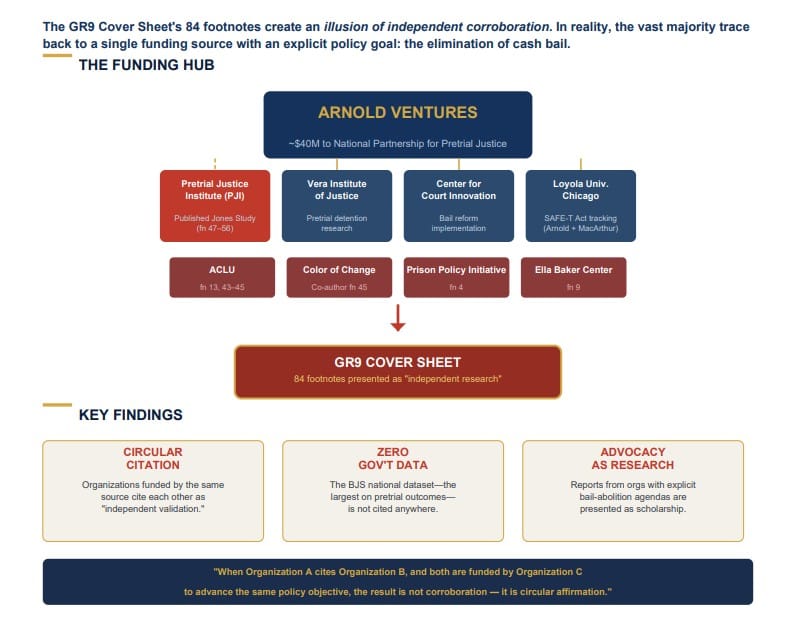
When a group of public defense organizations asked the Washington State Supreme Court to overhaul the state's bail system, they backed up their proposal with 84 footnotes. That sounds like a lot of research. But when you trace those citations back to their sources, a troubling pattern emerges.
The vast majority of the studies, reports, and policy papers cited in the proposal do not come from independent research institutions or government agencies. They come from a tight network of advocacy organizations that share the same funding source, cite each other's work, and have publicly stated goals of eliminating cash bail.
At the center of this network is Arnold Ventures, a Houston-based philanthropy founded by billionaire John Arnold. Arnold Ventures has committed hundreds of millions of dollars to pretrial justice reform, with an explicit focus on reducing and eliminating cash bail. The organization created the National Partnership for Pretrial Justice, and awarded nearly $40 million in grants to more than 20 organizations working toward that goal.
Here is how the citation chain works in practice.
The proposal's key empirical claim – that unsecured bonds produce the same court appearance rates as secured bonds – comes from a 2013 study published by the Pretrial Justice Institute. The Pretrial Justice Institute is an Arnold Ventures grantee. Its institutional mission is to end money bail. The study was written by a PJI staff member using data from a PJI-related project.
Other Arnold Ventures grantees whose work feeds into the same citation ecosystem include the Vera Institute of Justice, the Center for Court Innovation, and Loyola University Chicago's Center for Criminal Justice – which was funded by Arnold Ventures and the MacArthur Foundation to track Illinois's bail reform and produce data supporting the policy that Arnold Ventures funded advocacy groups to promote.
The ACLU reports cited in the proposal – including the widely quoted claim that the bail bond industry extracts $2.4 billion from low-income communities – were co-produced with Color of Change, another organization with an explicit bail abolition agenda. These publications are advocacy products, not disinterested research.
“When Organization A cites Organization B, and both are funded by Organization C to advance the same policy objective, the result is not corroboration — it is circular affirmation.”
Here is why this matters...when Organization A publishes a report, Organization B cites it, Organization C produces a summary citing both, and all three are funded by the same source to advance the same policy – that is not independent corroboration. That is a coordinated advocacy campaign presenting itself as a research consensus.
None of this means the underlying concerns are fabricated. Pretrial detention does cause real harm. Indigent defendants do face real barriers. But the question before the Court is not whether the current system has problems. The question is whether the specific mechanisms proposed – a $200 bail cap, a "willful flight" standard, a 10 percent deposit presumption – will maintain public safety and court appearance rates. And the evidence base for that specific question is far thinner than 84 footnotes suggest.
What is conspicuously absent from the proposal tells its own story. The Bureau of Justice Statistics' national dataset on pretrial release – the largest government study on this question – is not cited. It shows surety bonds outperforming unsecured alternatives on every metric. A peer-reviewed economics study in the Journal of Law and Economics reaching the same conclusion is not cited. Washington State's own statute recognizing bail agents as serving a "necessary and important purpose" in the justice system is not cited.
The proponents built their case by citing organizations that agree with them while omitting the government data and peer-reviewed research that does not. That is not a research foundation. It is an advocacy brief dressed up as one.
The comment period for these proposed rule changes runs through April 30, 2026. Comments can be submitted to the Clerk of the Washington State Supreme Court.
Email your letter to:
supreme@courts.wa.gov
In the subject line include the following:
Letter of Opposition to Proposed Amendments to CrR/CrRLJ 3.2 (Release of the Accused) and CrR/CrRLJ 2.2 (Warrant of Arrest and Summons) – Order No. 25700-A-1676
Read Part 1 of the 5-article series:




Member discussion