PART 1 of 5: Washington State Bail Reform

Why is Washington's Pretrial Release System Being Upended Based on a Single Study of 1,970 People
By JL Fullerton
This article is part one of a five-article series on the proposed court rules being considered in Washington State. These proposed rules would completely change one of the most efficient and effective bipartisan pretrial systems in the country. The big question is, why? Why is the supreme court even considering these proposed changes? Over the next several days, we will release five articles that uncover the extremely questionable data and misinformation that make up the rationale for the changes. Each article will dismantle the arguments being made as to why these changes are needed. Below is part 1.
Part 1: Washington State Bail Reform Proposal Built on a Single Study of 1,970 People
A proposal before the Washington State Supreme Court would cap bail at $200 for most misdemeanor offenses, replace the current failure-to-appear standard with a near-impossible "willful flight" test, and create a strong presumption that defendants can satisfy bail by depositing just 10% with the court clerk. The proponents – a group of public defense organizations led by the King County Department of Public Defense – say research supports these changes.
But when you look at the actual research they cite, there is a problem. The entire empirical case for the claim that unsecured bonds work just as well as secured bonds rests on a single study.
That study is called "Unsecured Bonds: The As Effective and Most Efficient Pretrial Release Option" (Jones, 2013). It was published by the Pretrial Justice Institute. The proponents cite it ten times in a row in their filing – footnotes 47 through 56 – making it the backbone of their argument.
Here is what the study actually looked at: approximately 1,970 defendants booked into 10 county jails in Colorado over a 16-month period from 2008 to 2009. That is a small sample from a single state, collected nearly two decades ago, using data that was originally gathered not to compare bond types but to build Colorado's pretrial risk assessment tool.
The study did not randomly assign defendants to secured or unsecured bonds. Judges chose the bond type based on their assessment of each defendant. That means the two groups being compared are fundamentally different. Judges put defendants they considered higher risk on secured bonds and lower-risk defendants on unsecured bonds. Comparing the outcomes of these two groups and concluding the bond type made no difference is like comparing the health outcomes of people who went to the emergency room with people who stayed home and concluding that emergency rooms do not help.
The study itself includes a disclaimer that most readers never see. In a footnote, it states that it "does not evaluate the effectiveness of commercial bail bonding in achieving court appearance results." That caveat directly undermines how the proponents use the study in their filing.
There is a much larger and more rigorous government dataset on this exact question that the proponents chose not to cite. The Bureau of Justice Statistics published a Special Report on Pretrial Release of Felony Defendants in State Courts (Cohen & Reaves, 2007), analyzing data from the 75 largest U.S. counties across multiple years from 1990 to 2004. That dataset is orders of magnitude larger than the Jones Study and has national scope.
The BJS data tells a very different story. Defendants released on surety bonds had a failure-to-appear rate of about 18 percent. Defendants released on their own recognizance had an FTA rate of 26 percent. Defendants released on unsecured bonds had an FTA rate of about 30 percent. The fugitive-after-one-year rate – meaning the defendant skipped court and was still missing a year later – was about 3 percent for surety bond defendants, compared to 8 percent for recognizance and 10 percent for unsecured bonds.
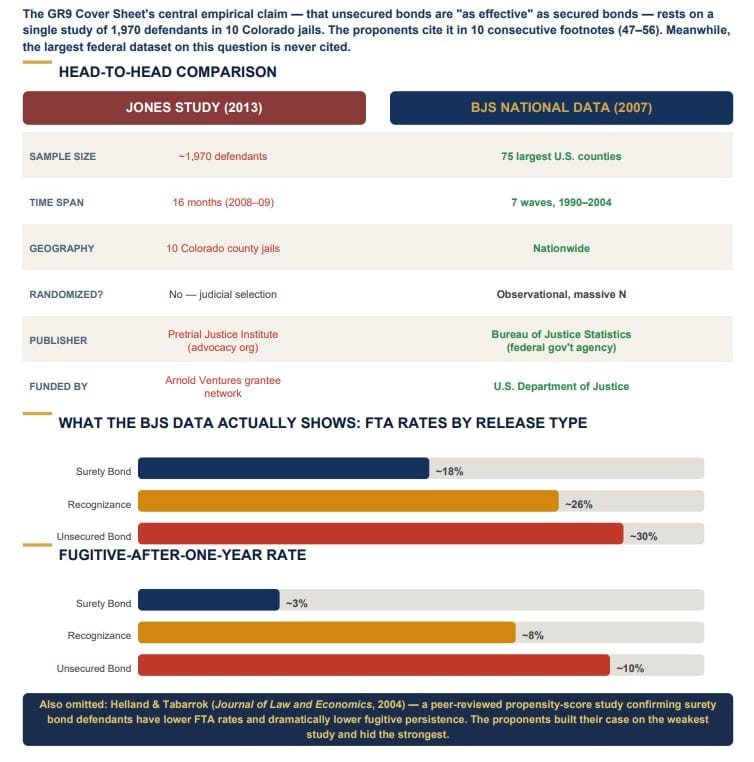
A separate peer-reviewed pretrial release study by economists Helland and Tabarrok, published in the Journal of Law and Economics (2004), used sophisticated matching methods to compare similar defendants and found the same pattern: surety bonds produced lower FTA rates and dramatically lower fugitive rates.
The proponents did not mention any of this. Not the BJS data. Not the Helland and Tabarrok study. Not any of the research showing that surety bonds outperform alternatives on court appearance and fugitive recovery.
Lastly, the proponents also don't mention the letter that was sent by the Jefferson County, Colorado Sheriff, County Commissioner and District Attorney to the Maryland Supreme Court warning them of misleading statements regarding the success of bail reform in their county. The same county the Jones Study cites as a success. The letter dated December 22, 2016 states the following:
------------------------------------------------------------------------------------------------
Re: Proposed Amendment by Standing Committee on Practice and Procedure Regarding Rules of Criminal Procedure on Pretrial Release
Your Honors:
We write jointly to respond to a specific statement made in the November 22, 2016, letter you received with proposed changes to the Rules of Criminal Procedure in Maryland. Specifically, we write to address the misleading statements about the use of unsecured bonds in Colorado.
In 2013, our county shifted towards an unsecured bond system with the support of our pretrial services agency. The program did not work as intended. We did not save budget dollars. The system suffers from a lack of accountability. The District Attorney’s office originally had significant objections and concerns for public safety due to the bail reform initiative and those objections and concerns persist.
The use of financial bail, including the use of commercial sureties, has been reintroduced into the system. We believe accountability has improved and as a system we are functioning better.
Fairness must be balanced against costs and the concern associated with the lack of accountability of the defendant and increased risk to the safety of the public. Financial bail is a very important tool, and it will continue in use in Jefferson County, Colorado.
------------------------------------------------------------------------------------------------
Washington's courts deserve to know that the proposal in front of them is not built on a broad foundation of research. It is built on a single advocacy-produced study of fewer than 2,000 people in Colorado, while the largest government dataset available on the same question reaches the opposite conclusion.
The comment period for these proposed rule changes runs through April 30, 2026. Comments can be submitted to the Clerk of the Washington State Supreme Court.
Email your letter to:
supreme@courts.wa.gov
In the subject line include the following:
Letter of Opposition to Proposed Amendments to CrR/CrRLJ 3.2 (Release of the Accused) and CrR/CrRLJ 2.2 (Warrant of Arrest and Summons) – Order No. 25700-A-1676



Member discussion