Mississippi Bail Bonds: A Failure of Oversight and Accountability
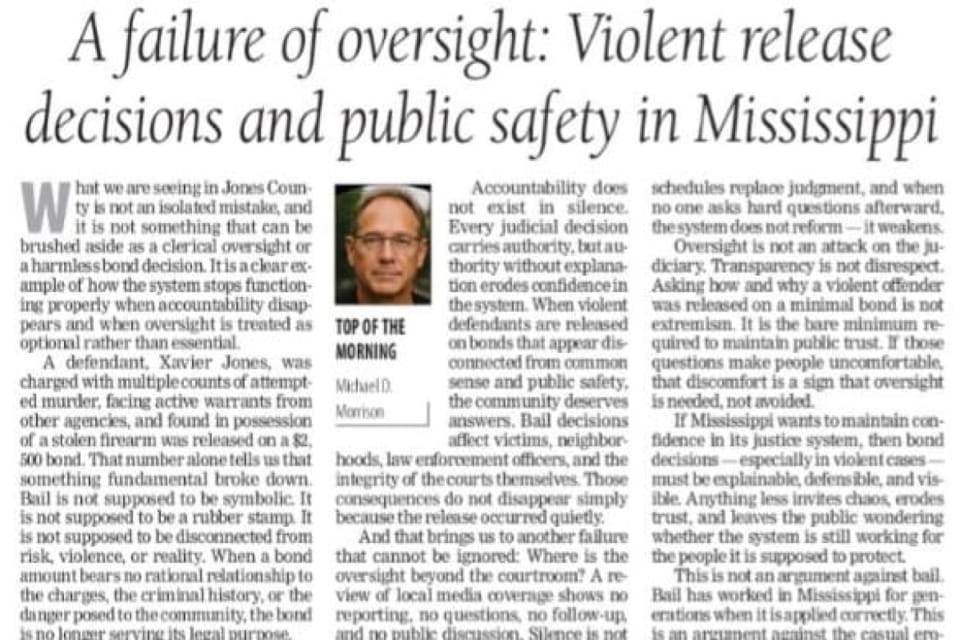
In Jones County, Mississippi, a high-risk pretrial release case has exposed critical flaws in how bail bonds are determined for violent offenders. A defendant charged with multiple counts of attempted murder, holding active warrants from other agencies, and found in possession of a stolen firearm was granted pretrial release on an unusually low $2,500 bond. President of the Mississippi Bail Agent Association, Mike Morrison, penned an Opinion piece in The Natchez Democrat in response. According to Mr. Morrison, Mississippi Supreme Court Rule 8 explicitly requires judges to weigh the nature and violence of the offense, firearm involvement, prior criminal conduct, outstanding warrants, and the danger to the community before approving any bail bonds decision. Yet this pretrial release appears disconnected from those mandatory factors, raising urgent questions about whether proper risk assessment was conducted or if the bond amount was simply a procedural shortcut rather than a defensible public safety measure.
The absence of judicial explanation, media scrutiny, or follow-up oversight in this pretrial release has further eroded public confidence in local bail bonds practices, leaving victims of alleged attempted murder without clear protective measures or notifications. While bail bonds remain a longstanding and effective tool in Mississippi when applied responsibly, this case illustrates how failures in pretrial release protocols—without transparency or accountability—can weaken the entire system. Greater adherence to Rule 8, documented reasoning for all bail bonds decisions in violent cases, and active public discussion are essential to ensure pretrial release prioritizes community safety over convenience. Below is an excerpt from the article…
A Failure of Oversight: Violent Release Decisions and Public Safety in Jones County.
By Mike Morrison
What we are seeing in Jones County is not an isolated mistake, and it is not something that can be brushed aside as a clerical oversight or a harmless bond decision. It is a clear example of how the system stops functioning properly when accountability disappears and when oversight is treated as optional rather than essential. READ THE FULL ARTICLE HERE>>>





Member discussion